Interesting event in Amsterdam and interesting definition for Smart City applications.
It looks like our SpotEx is a perfect fit for Smart City applications.
Sunday, January 29, 2012


About Facebook fans
Free WiFi for check-in. Looks like this, is not it?
"Why doesn’t everyone do this? It is clearly a better return than some CPM ad that users are dying to get away from… it’s relevant, not spammy and surprisingly welcome." - sure :)
"Why doesn’t everyone do this? It is clearly a better return than some CPM ad that users are dying to get away from… it’s relevant, not spammy and surprisingly welcome." - sure :)
Wednesday, January 25, 2012
About customized check-ins for Facebook Places
You are welcome to check out a new version of our mashup Places from Facebook.
Lets you search for places, show them on the map, copy locations to mobile, check-in anywhere as well as prepare mobile web pages for customized check-ins.
You can directly pass the following parameters to the basic URL:
lat - latitude
lng - longitude
q - query for search
For example, Facebook in London
For customized check-in place owner (or advertising/marketing agency, for example) can define all the aspects of check-in - data to be posted on user's wall, data to be returned as a confirmation, Google Analytics code for stats monitoring etc. This version provides own analytics for check-ins too. And of course you still can use Facebook’s dashboard for places pages - mashup creates standard check-ins for Facebook.
In other words – any small business can create public (or private) "Foursquare-like" system for own visitors. Using all the power of Facebook’s user base.
P.S. See also QRpon – customized check-ins for Facebook
P.P.S. and here you can see Places from Google for the same area.
Lets you search for places, show them on the map, copy locations to mobile, check-in anywhere as well as prepare mobile web pages for customized check-ins.
You can directly pass the following parameters to the basic URL:
lat - latitude
lng - longitude
q - query for search
For example, Facebook in London
For customized check-in place owner (or advertising/marketing agency, for example) can define all the aspects of check-in - data to be posted on user's wall, data to be returned as a confirmation, Google Analytics code for stats monitoring etc. This version provides own analytics for check-ins too. And of course you still can use Facebook’s dashboard for places pages - mashup creates standard check-ins for Facebook.
In other words – any small business can create public (or private) "Foursquare-like" system for own visitors. Using all the power of Facebook’s user base.
P.S. See also QRpon – customized check-ins for Facebook
P.P.S. and here you can see Places from Google for the same area.
Tuesday, January 24, 2012
Random Images
Our JSOS collection is growing again. Random Image servlet lets you display random images in your Java web applications.
Monday, January 23, 2012
Places from tweets
Yet another our mashup has been updated - Location from Twitter.
Usually, the bundle Twitter + Maps always means mapping twits and show them on the map. Yes, we have such mashups too (see for example, Photo map или Local twitter). But here everything is vice versa. It is just a reverse task.
Suppose you are reading a great geo-located twit. Just a status associated with some place (location). In Twitter's web client you can see that place and an appropriate icon just below the message. How to get that place info and save/bookmark it on your phone? It is what our mashup - Places from Twitter is for.
It is very similar to our Location bookmark, but with Twitter status instead of address. Mashup Locations from Twitter also creates QR code for mobile map. And mobile map describes a place from Twitter. And here we are using Geo Messages again.
The usage is simple. Just open in Twitter’s web interface any geo-enabled twit and copy its URL to mashup’s form. Also you can save the following link Place from Twitter in your bookmarks and simply select that bookmark on any opened page with geo-enabled twit (it is so called bookmarklet).
And of course, any QR code created with this mashup could be placed anywhere – on your site/blog, Facebook wall etc. You can even print it and place on the physical wall. Mashup provides HTML code you need for embedding QR code image.
Usually, the bundle Twitter + Maps always means mapping twits and show them on the map. Yes, we have such mashups too (see for example, Photo map или Local twitter). But here everything is vice versa. It is just a reverse task.
Suppose you are reading a great geo-located twit. Just a status associated with some place (location). In Twitter's web client you can see that place and an appropriate icon just below the message. How to get that place info and save/bookmark it on your phone? It is what our mashup - Places from Twitter is for.
It is very similar to our Location bookmark, but with Twitter status instead of address. Mashup Locations from Twitter also creates QR code for mobile map. And mobile map describes a place from Twitter. And here we are using Geo Messages again.
The usage is simple. Just open in Twitter’s web interface any geo-enabled twit and copy its URL to mashup’s form. Also you can save the following link Place from Twitter in your bookmarks and simply select that bookmark on any opened page with geo-enabled twit (it is so called bookmarklet).
And of course, any QR code created with this mashup could be placed anywhere – on your site/blog, Facebook wall etc. You can even print it and place on the physical wall. Mashup provides HTML code you need for embedding QR code image.
DLD 2012
We continue to share links for monitoring the interesting events in Twitter. Now it is DLD, Munich, 2011
/via Geo Messages
P.S. and the same in Twi-gazeta: DLD
/via Geo Messages
P.S. and the same in Twi-gazeta: DLD
Sunday, January 22, 2012
Closed Graph API
Bad news from Google about Social Graph API: "This API makes information about the public connections between people on the web available for developers. The API isn’t experiencing the kind of adoption we’d like, and is being deprecated as of today. It will be fully retired on April 20, 2012." - from here
Sad. It is actually a good toolkit that lets for example provide WHOIS service for Twitter (e.g. search for other resources related to your new follower) or find more sites linked to the given URL
Sad. It is actually a good toolkit that lets for example provide WHOIS service for Twitter (e.g. search for other resources related to your new follower) or find more sites linked to the given URL
Thursday, January 19, 2012
Four Cool Ways to Use a VNC Server
"In this article, I’m going to put together four remote-control systems that you can use to control various entertainment and display systems throughout your home, from a single, central computer. This is especially useful for those of you that have a "main" computer in your living room or living area that everyone uses." - very practical solutions for remote monitoring.
Tuesday, January 17, 2012
Data Mining: Finding Similar Items and Users
A good introduction: Euclidean Distance, similarity, Pearson Correlation Coefficient - see it here.
Monday, January 16, 2012
Lists in Twitter
Our mashup Lists from Twitter has been updated. Lets you extract popular topics from Twitter lists. Just set a name for the list (twitter_name/list_name) on the mashup’s page or directly provide it as a parameter:
http://tlist.linkstore.ru?u=some_list
For example:
abava/mobile
Scobleizer/geolocation
http://tlist.linkstore.ru?u=some_list
For example:
abava/mobile
Scobleizer/geolocation
Saturday, January 14, 2012
Proximity applications
An interesting presentation:
Interesting by the way what they can do with iOS that prohibits Wi-Fi scanning.
Our own project in this area is SpotEx
LocalSocial App Overview
View more presentations from Sean O Sullivan
Interesting by the way what they can do with iOS that prohibits Wi-Fi scanning.
Our own project in this area is SpotEx
Thursday, January 12, 2012
Proximity as a service
Indoor positioning at this moment is a hot area for LBS applications. There is no common denominator for indoor location but technically Wi-Fi based solutions are probably prevailing.
Wi-Fi based approach for indoor positioning is always based on the net of basic nodes (Wi-Fi tags for example) with known locations. Based on that we can deploy some triangulation for getting position for our Wi-Fi device. Actually, it is similar to cell-id, where Wi-Fi tags play the role of base stations.
So, the main problem is the need for some preliminary preparation steps for Wi-Fi network we are going to use for indoor positioning. And what if we need some dynamic solutions? It is actually a starting point for our SpotEx (Spot expert) project.
What if we will take from traditional indoor positioning systems the first step only – Wi-Fi networks detection? Obviously, if our mobile phone can see some Wi-Fi access point we are somewhere nearby. And the word “nearby” actually dictates that we should use proximity services rather than traditional location based services. That is probably fine because the proximity (being nearby) let us directly provide the relevant content to our users, without the preliminary geo-calculations. But we need some tools that let us add measurement to the word “nearby”. Similar to the geo-location tools we need services for proximity based operations.
Our SpotEx model presents one of possible tools for the proximity services. And as the second step in our “new indoor approach” we will add the ability describe some content that depends on the Wi-Fi networks visibility. We will get some kind of context aware браузер – our user will see content depends on the exiting Wi-Fi access points. Actually, we can add rules for the visibility where we can use Wi-Fi, time, probability, history of access etc.
We do not need in this case any preliminary preparation for that network. We can proceed even dynamically added nodes. For example, Wi-Fi access point we can associate our rules with could be Wi-Fi access point opened by demand right on another mobile phone.
Once again – it is not about access to some Wi-Fi network. Access point could be protected and closed for public access. The only thing Spot Expert is based on is its visibility. Access point plays a role of sensor (trigger) here. If our mobile user can see that network he/she is nearby.
Current implementation provides Android application for end users and web client (including mobile web) for creating rules and setting content nodes. See Spot expert site for details and application downloading.
Possible use cases are: delivering commercial information (deals, discounts, coupons) in malls, hyper-local news data, data discovery in Smart City projects, personal news sites etc
There is also a special simplified version prepared for retail area – In Mall Notes. Contact us for demo access.
A side effect - WiFi chat. This service provides the predefined elements of content: web chat and discussion groups connected to some visible Wi-Fi access point. Suppose we have some Wi-Fi network in train (bus etc.) WiFi chat application provides communication tools for people in the net’s area. You can get more details in our article about WiFi chat.
Wi-Fi based approach for indoor positioning is always based on the net of basic nodes (Wi-Fi tags for example) with known locations. Based on that we can deploy some triangulation for getting position for our Wi-Fi device. Actually, it is similar to cell-id, where Wi-Fi tags play the role of base stations.
So, the main problem is the need for some preliminary preparation steps for Wi-Fi network we are going to use for indoor positioning. And what if we need some dynamic solutions? It is actually a starting point for our SpotEx (Spot expert) project.
What if we will take from traditional indoor positioning systems the first step only – Wi-Fi networks detection? Obviously, if our mobile phone can see some Wi-Fi access point we are somewhere nearby. And the word “nearby” actually dictates that we should use proximity services rather than traditional location based services. That is probably fine because the proximity (being nearby) let us directly provide the relevant content to our users, without the preliminary geo-calculations. But we need some tools that let us add measurement to the word “nearby”. Similar to the geo-location tools we need services for proximity based operations.
Our SpotEx model presents one of possible tools for the proximity services. And as the second step in our “new indoor approach” we will add the ability describe some content that depends on the Wi-Fi networks visibility. We will get some kind of context aware браузер – our user will see content depends on the exiting Wi-Fi access points. Actually, we can add rules for the visibility where we can use Wi-Fi, time, probability, history of access etc.
We do not need in this case any preliminary preparation for that network. We can proceed even dynamically added nodes. For example, Wi-Fi access point we can associate our rules with could be Wi-Fi access point opened by demand right on another mobile phone.
Once again – it is not about access to some Wi-Fi network. Access point could be protected and closed for public access. The only thing Spot Expert is based on is its visibility. Access point plays a role of sensor (trigger) here. If our mobile user can see that network he/she is nearby.
Current implementation provides Android application for end users and web client (including mobile web) for creating rules and setting content nodes. See Spot expert site for details and application downloading.
Possible use cases are: delivering commercial information (deals, discounts, coupons) in malls, hyper-local news data, data discovery in Smart City projects, personal news sites etc
There is also a special simplified version prepared for retail area – In Mall Notes. Contact us for demo access.
A side effect - WiFi chat. This service provides the predefined elements of content: web chat and discussion groups connected to some visible Wi-Fi access point. Suppose we have some Wi-Fi network in train (bus etc.) WiFi chat application provides communication tools for people in the net’s area. You can get more details in our article about WiFi chat.
Wednesday, January 11, 2012
Local chat and forum
Our mobile web application WiFi chat has been updated again. What kind of object (real or virtual) can we use for joining together mobile users? We are not talking here about social networks members. We are looking a way for creating group chat. Here, for example, is a short list for several our applications:
City forum - discussions (forums) linked to places (POI - point of interest)
Geo forum - the similar to above (also mobile forums) but linked to location
Mobile forum - lets you add discussions to any physical object.
City chat - web chat linked to any POI (point of interest)
Geo chat - web chat linked to some location
And here is our new idea - Wi-Fi Chat. Forum and chat linked to some Wi-Fi network. It is a mobile application that lets you see available (visible) Wi-Fi networks and link (attach) discussions and chats to them. We are not talking about connecting to Wi-Fi networks. We are using any Wi-Fi network just as a sensor. If you can see it from your mobile, you are somewhere near. We can call it Wi-Fi proximity. That is an idea. All people seeing the same network are in the some proximity. So, they could have some common points for the discussions.
Just one interesting remark – Wi-Fi access point could be opened right on the mobile phone. And with WiFi chat application this phone will play a role of presence sensor uniting (combining together) local people for the communications.
Technically this application uses cloud forums from Disqus and web chat from Coldbeans.
You can load .apk right from Android Market:
com.wifichat
Also you can download .apk file right from our server: http://servletsuite.com/WiFiChat.apk. Here is an appropriate QR-code:

WiFi chat, actually, is a side project for our new development - SpotEx. This application uses ideas of proximity as a service and lets you attach (link) your own data to Wi-Fi access points. We will describe it separately.
City forum - discussions (forums) linked to places (POI - point of interest)
Geo forum - the similar to above (also mobile forums) but linked to location
Mobile forum - lets you add discussions to any physical object.
City chat - web chat linked to any POI (point of interest)
Geo chat - web chat linked to some location
And here is our new idea - Wi-Fi Chat. Forum and chat linked to some Wi-Fi network. It is a mobile application that lets you see available (visible) Wi-Fi networks and link (attach) discussions and chats to them. We are not talking about connecting to Wi-Fi networks. We are using any Wi-Fi network just as a sensor. If you can see it from your mobile, you are somewhere near. We can call it Wi-Fi proximity. That is an idea. All people seeing the same network are in the some proximity. So, they could have some common points for the discussions.
Just one interesting remark – Wi-Fi access point could be opened right on the mobile phone. And with WiFi chat application this phone will play a role of presence sensor uniting (combining together) local people for the communications.
Technically this application uses cloud forums from Disqus and web chat from Coldbeans.
You can load .apk right from Android Market:
com.wifichat
Also you can download .apk file right from our server: http://servletsuite.com/WiFiChat.apk. Here is an appropriate QR-code:
WiFi chat, actually, is a side project for our new development - SpotEx. This application uses ideas of proximity as a service and lets you attach (link) your own data to Wi-Fi access points. We will describe it separately.
Tuesday, January 10, 2012
About Open Graph
"Facebook’s ambitious plan to weave together the actions we take across the web and engineer a social network replete with frictionless sharing is finally ready to be deployed, VentureBeat has learned. The remaining pieces of Facebook’s new Open Graph are in the final stages of testing and are nearing release" - from here.
I am really not sure, why frictionless sharing is good. If I just read something it does not mean that I will automatically share that with my friends. And it is not about privacy, it is about spam :)
P.S. And here you can share your search query with your FB circle: Ask friends. And it requires friction :)
I am really not sure, why frictionless sharing is good. If I just read something it does not mean that I will automatically share that with my friends. And it is not about privacy, it is about spam :)
P.S. And here you can share your search query with your FB circle: Ask friends. And it requires friction :)
Monday, January 09, 2012
JSOS ver. 7.60
Coldbeans Software announced the next milestone in JSOS (servlets office suite) development. JSOS reaches the version 7.60.
This largest collection of Java servlets and filters provides 150+ "out of the box" components ready for building web-pages. One of the biggest parts is the rich set of filters. Package includes such components as XML and WML transcoding, access restriction, traffic restriction, caching, profiling etc. All components are configurable, so you may incorporate them into your own design frameset. Components from JSOS do support mobile web, so the same set of components can be used for wireless users too. At this moment JSOS provides a largest set of servlets and filters over the Net.
Check out the latest version of Java Servlets Office Suite here: http://www.servletsuite.com
This largest collection of Java servlets and filters provides 150+ "out of the box" components ready for building web-pages. One of the biggest parts is the rich set of filters. Package includes such components as XML and WML transcoding, access restriction, traffic restriction, caching, profiling etc. All components are configurable, so you may incorporate them into your own design frameset. Components from JSOS do support mobile web, so the same set of components can be used for wireless users too. At this moment JSOS provides a largest set of servlets and filters over the Net.
Check out the latest version of Java Servlets Office Suite here: http://www.servletsuite.com
Friday, January 06, 2012
Customized check-ins for Facebook places
You are welcome to check out a new version of our mashup Places from Facebook.
Lets you search for places, show them on the map, copy locations to mobile, check-in anywhere as well as prepare mobile web pages for customized check-ins. For customized check-in place owner (or advertising/marketing agency, for example) can define all the aspects of check-in - data to be posted on user's wall, data to be returned as a confirmation, Google Analytics code for stats monitoring etc.
You can directly pass the following parameters to the basic URL:
lat - latitude
lng - longitude
q - query for search
For example, Facebook in London
P.S. See also QRpon – customized check-ins for Facebook
Lets you search for places, show them on the map, copy locations to mobile, check-in anywhere as well as prepare mobile web pages for customized check-ins. For customized check-in place owner (or advertising/marketing agency, for example) can define all the aspects of check-in - data to be posted on user's wall, data to be returned as a confirmation, Google Analytics code for stats monitoring etc.
You can directly pass the following parameters to the basic URL:
lat - latitude
lng - longitude
q - query for search
For example, Facebook in London
P.S. See also QRpon – customized check-ins for Facebook
Thursday, January 05, 2012
Hyper-local chat and forum
Our mobile web application WiFi chat has been updated again. What kind of object (real or virtual) can we use for joining together mobile users? We are not talking here about social networks members. We are looking a way for creating group chat. Here, for example, is a short list for several our applications:
City forum - discussions (forums) linked to places (POI - point of interest)
Geo forum - the similar to above (also mobile forums) but linked to location
Mobile forum - lets you add discussions to any physical object.
City chat - web chat linked to any POI (point of interest)
Geo chat - web chat linked to some location
And here is our new idea - WiFiChat. Forum and chat linked to some WiFi network. It is a mobile application that lets you see available (visible) Wi-Fi networks and link (attach) discussions and chats to them. We are not talking about connecting to WiFi networks. We are using any WiFi network just as a sensor. If you can see it from your mobile, you are somewhere near. We can call it WiFi proximity. That is an idea. All people seeing the same network are in the some proximity. So, they could have some common points for the discussions.
Just one interesting remark – WiFi access point could be opened right on the mobile phone. And with WiFiChat application this phone will play a role of presence sensor uniting (combining together) local people for the communications.
Technically this application uses cloud forums from Disqus and web chat from Coldbeans.
You can load .apk right from Android Market:
com.wifichat
Also you can download .apk file right from our server: http://servletsuite.com/WiFiChat.apk. Here is an appropriate QR-code:
WiFiChat, actually, is a side project for our new development - SpotEx. This application lets you attach (link) your own data to WiFi access points. We will describe it separately.
City forum - discussions (forums) linked to places (POI - point of interest)
Geo forum - the similar to above (also mobile forums) but linked to location
Mobile forum - lets you add discussions to any physical object.
City chat - web chat linked to any POI (point of interest)
Geo chat - web chat linked to some location
And here is our new idea - WiFiChat. Forum and chat linked to some WiFi network. It is a mobile application that lets you see available (visible) Wi-Fi networks and link (attach) discussions and chats to them. We are not talking about connecting to WiFi networks. We are using any WiFi network just as a sensor. If you can see it from your mobile, you are somewhere near. We can call it WiFi proximity. That is an idea. All people seeing the same network are in the some proximity. So, they could have some common points for the discussions.
Just one interesting remark – WiFi access point could be opened right on the mobile phone. And with WiFiChat application this phone will play a role of presence sensor uniting (combining together) local people for the communications.
Technically this application uses cloud forums from Disqus and web chat from Coldbeans.
You can load .apk right from Android Market:
com.wifichat
Also you can download .apk file right from our server: http://servletsuite.com/WiFiChat.apk. Here is an appropriate QR-code:
WiFiChat, actually, is a side project for our new development - SpotEx. This application lets you attach (link) your own data to WiFi access points. We will describe it separately.
Wednesday, January 04, 2012
Wednesday, December 28, 2011
Mobile ID card for Facebook
Our mashup Mobile Facebook ID card has been updated. It lets you create mobile identification card with your Facebook ID.
Mashup lets you create mobile web page with QR code that presents your name and photo from Facebook. This mobile web page could be simply bookmarked (saved) right on your mobile phone. You can present (show) this QR code (opened mobile page) on the some check-in point (gate etc). QR code could be scanned right from your phone and your ID could be checked. You can see screenshots for the process here: how to confirm your identity with Facebook.
ID Card (mobile web page) contains a link to your Facebook profile. So this mashup could be used also as a quick way for telling about your Facebook page to other people.
Other use cases are:
- loyalty cards
- mobile tickets
- events registration
Mashup lets you create mobile web page with QR code that presents your name and photo from Facebook. This mobile web page could be simply bookmarked (saved) right on your mobile phone. You can present (show) this QR code (opened mobile page) on the some check-in point (gate etc). QR code could be scanned right from your phone and your ID could be checked. You can see screenshots for the process here: how to confirm your identity with Facebook.
ID Card (mobile web page) contains a link to your Facebook profile. So this mashup could be used also as a quick way for telling about your Facebook page to other people.
Other use cases are:
- loyalty cards
- mobile tickets
- events registration
Tuesday, December 27, 2011
Read JSON in Java
An interesting trick. You can easily transform a JSON expression to a simple Java object tree (map, arrays, primitive wrappers and string) with Java 6 and no additional framework. Actually, Java code uses JavaScript for getting objects from JSON. From here.
Friday, December 23, 2011
Emergency communications for drivers
Geo Messages concept proposes adding location data as signatures to messages. And this model could be actually embedded into some vertical applications (services). Here is an example - InCar emergency.
This mashup provides a generator for in-car emergency communications. Service provider (renting agency) prepares a communication script for cars owners. This script contains some predefined-data (car model, year) and uses GeoMessages for adding location info during the deployment. Such script could be preloaded to driver’s phone or placed via QR-code right in the car. It is a fast way for emergency communications.
P.S. in the more generic form the similar approach provided in Geo Post mashup that lets add geo-located messages to blogs.
This mashup provides a generator for in-car emergency communications. Service provider (renting agency) prepares a communication script for cars owners. This script contains some predefined-data (car model, year) and uses GeoMessages for adding location info during the deployment. Such script could be preloaded to driver’s phone or placed via QR-code right in the car. It is a fast way for emergency communications.
P.S. in the more generic form the similar approach provided in Geo Post mashup that lets add geo-located messages to blogs.
Thursday, December 22, 2011
Cache for JSP
It is yet another solution for data caching in heavy loaded JSP sites. Custom JSP tag, helps you provide session level cache. Tag Once Per Session lets you calculate code chunks just once per user’s session and reuse cached data in the subsequent calls.
Wednesday, December 21, 2011
Software Deployment: Challenges and Successes
Guest post by David Malmborg. David works with Dell Kace and enjoys writing about technology, computers and saving money.
In the early days of business software, deployment was relatively simple. When a software upgrade was needed, companies bought software CDs through retail vendors and installed it onto their machines. Today, things are a little more complicated. The internet revolutionized the way software is sold, but it also opened the door to rampant software piracy. Software vendors, then, of necessity, became stricter in terms of both licensing and auditing.
Modern enterprise software deployment is more than just getting the right applications to the right people at the right time. In fact, software “deployment” can really be called software “management”— that is, an IT professional’s job does not end with the successful rollout of a software update. It’s more about managing software and software licensing year round.
Software Deployment Challenges
Poor software deployment can lead to a number of issues. One such has already been mentioned, but those companies that do not handle it properly can find themselves charged with hefty fines: illegal software usage. Unfortunately, this is sometimes not as easy to control as would be hoped. Employees may not understand all the implications of software licensing when downloading or otherwise installing software on their machines.
Another issue that many IT professionals run into is support. When attempting software upgrades, it is often not a simple matter of installing, but of making sure that users’ existing hardware, software, data, and preferences are compliant with the new application. This is especially important when making moving from one OS to another. Though there are tools that attempt to make the process easier, it is
often one that requires time to complete. A typical operating system update can take most companies anywhere from a year and a half to two years.
Other challenges include overbuying, fitting the upgrade into the workload of already-busy employees, and supporting newer technologies. It is for these reasons that successful software distribution is a full time job.
Deployment Methodology
There are resources and things that IT professionals can do to make software deployment a little more manageable, however.
Plan in advance – It’s almost a guarantee that there will be problems with software
deployment, but professionals that plan in advance for these eventualities are often the most successful. In order to do this, it is a good idea to involve both the end users and any support staff in the planning processes.
Repackage software – Software distribution is often best handled through a centralized software library. This provides ease of access and control of updates. This system also allows the right software versions to be transferred to the right employees.
Schedule software distribution – When software deployment takes place is just as important as how it happens. A good time to schedule distribution is during times of low bandwidth usage and during times that users are not actively working on their machines.
Train employees – Sometimes management makes the decision to forego training in order to cut back on costs, but this is often an essential step. Users need to understand the new software features as well as how their work routines could change.
Software deployment can be complex and time-consuming, but it is a vital part of most businesses. With the right strategies in place, software deployment can go smoothly.
In the early days of business software, deployment was relatively simple. When a software upgrade was needed, companies bought software CDs through retail vendors and installed it onto their machines. Today, things are a little more complicated. The internet revolutionized the way software is sold, but it also opened the door to rampant software piracy. Software vendors, then, of necessity, became stricter in terms of both licensing and auditing.
Modern enterprise software deployment is more than just getting the right applications to the right people at the right time. In fact, software “deployment” can really be called software “management”— that is, an IT professional’s job does not end with the successful rollout of a software update. It’s more about managing software and software licensing year round.
Software Deployment Challenges
Poor software deployment can lead to a number of issues. One such has already been mentioned, but those companies that do not handle it properly can find themselves charged with hefty fines: illegal software usage. Unfortunately, this is sometimes not as easy to control as would be hoped. Employees may not understand all the implications of software licensing when downloading or otherwise installing software on their machines.
Another issue that many IT professionals run into is support. When attempting software upgrades, it is often not a simple matter of installing, but of making sure that users’ existing hardware, software, data, and preferences are compliant with the new application. This is especially important when making moving from one OS to another. Though there are tools that attempt to make the process easier, it is
often one that requires time to complete. A typical operating system update can take most companies anywhere from a year and a half to two years.
Other challenges include overbuying, fitting the upgrade into the workload of already-busy employees, and supporting newer technologies. It is for these reasons that successful software distribution is a full time job.
Deployment Methodology
There are resources and things that IT professionals can do to make software deployment a little more manageable, however.
Plan in advance – It’s almost a guarantee that there will be problems with software
deployment, but professionals that plan in advance for these eventualities are often the most successful. In order to do this, it is a good idea to involve both the end users and any support staff in the planning processes.
Repackage software – Software distribution is often best handled through a centralized software library. This provides ease of access and control of updates. This system also allows the right software versions to be transferred to the right employees.
Schedule software distribution – When software deployment takes place is just as important as how it happens. A good time to schedule distribution is during times of low bandwidth usage and during times that users are not actively working on their machines.
Train employees – Sometimes management makes the decision to forego training in order to cut back on costs, but this is often an essential step. Users need to understand the new software features as well as how their work routines could change.
Software deployment can be complex and time-consuming, but it is a vital part of most businesses. With the right strategies in place, software deployment can go smoothly.
Tuesday, December 20, 2011
Hyper-local communications
Our mobile web application WiFi chat has been updated. What kind of object (real or virtual) can we use for joining together mobile users? We are not talking here about social networks members. We are looking a way for creating group chat. Here, for example, is a short list for several our applications:
City forum - discussions (forums) linked to places (POI - point of interest)
Geo forum - the similar to above (also mobile forums) but linked to location
Mobile forum - lets you add discussions to any physical object.
City chat - web chat linked to any POI (point of interest)
Geo chat - web chat linked to some location
And here is a new idea - WiFiChat. Forum and chat linked to some WiFi network. It is a mobile application that lets you see available (visible) Wi-Fi networks and link (attach) discussions and chats to them. We are not talking about connecting to WiFi networks. We are using WiFi network just as a sensor. If you can see it from your mobile, you are somewhere near. We can call it WiFi proximity. That is an idea. All people seeing the same network are in the some proximity. So, they could have some common points for the discussions.
Just one interesting remark – WiFi access point could be opened right on the mobile phone. And with WiFiChat application this phone will play a role of presence sensor uniting (combining together) local people for the communications.
Technically this application uses cloud forums from Disqus and web chat from Coldbeans.
You can load .apk right from Android Market:
com.wifichat
Also you can download .apk file right from our server: http://servletsuite.com/WiFiChat.apk. Here is an appropriate QR-code:
WiFiChat, actually, is a side project for our new development - SpotEx. This application lets you attach (link) your own data to WiFi access points. We will describe it separately.
City forum - discussions (forums) linked to places (POI - point of interest)
Geo forum - the similar to above (also mobile forums) but linked to location
Mobile forum - lets you add discussions to any physical object.
City chat - web chat linked to any POI (point of interest)
Geo chat - web chat linked to some location
And here is a new idea - WiFiChat. Forum and chat linked to some WiFi network. It is a mobile application that lets you see available (visible) Wi-Fi networks and link (attach) discussions and chats to them. We are not talking about connecting to WiFi networks. We are using WiFi network just as a sensor. If you can see it from your mobile, you are somewhere near. We can call it WiFi proximity. That is an idea. All people seeing the same network are in the some proximity. So, they could have some common points for the discussions.
Just one interesting remark – WiFi access point could be opened right on the mobile phone. And with WiFiChat application this phone will play a role of presence sensor uniting (combining together) local people for the communications.
Technically this application uses cloud forums from Disqus and web chat from Coldbeans.
You can load .apk right from Android Market:
com.wifichat
Also you can download .apk file right from our server: http://servletsuite.com/WiFiChat.apk. Here is an appropriate QR-code:
WiFiChat, actually, is a side project for our new development - SpotEx. This application lets you attach (link) your own data to WiFi access points. We will describe it separately.
Monday, December 19, 2011
Directory of mashups
Our mashups directory has been updated. A huge collection of applications: Facebook, Twitter, Google Maps, LBS, QR-codes, mobile HTML5 etc.
The latest release includes our context-aware applications (WiFi Chat), Google Plus API test (photo puzzle) and new Chrome extensions, for example
The latest release includes our context-aware applications (WiFi Chat), Google Plus API test (photo puzzle) and new Chrome extensions, for example
Sunday, December 18, 2011
Real time search for Hadoop
Interesting article: search in log files with a clever combination of Hadoop with Lucene and Solr.
Friday, December 16, 2011
iOS5 Bluetooth
An interesting article about Core Bluetooth Framework in iOS:
Billboards would be able to broadcast coupons to nearby patrons - no cell reception needed.
A jukebox might advertise the song that’s currently playing with a link to purchase
Your car could broadcast its stats so that when you pull into a gas station the service mechanics will know whether you need an oil change.
Your company badge might broadcast your email address so that connecting at business events becomes even easier.
Your TV could broadcast the link to the current TV channel’s website.
Note, that everything is a push and so has got all the security problems. In the same time our SpotEx approach propagates the pull. And it is safety and anonymous.
Billboards would be able to broadcast coupons to nearby patrons - no cell reception needed.
A jukebox might advertise the song that’s currently playing with a link to purchase
Your car could broadcast its stats so that when you pull into a gas station the service mechanics will know whether you need an oil change.
Your company badge might broadcast your email address so that connecting at business events becomes even easier.
Your TV could broadcast the link to the current TV channel’s website.
Note, that everything is a push and so has got all the security problems. In the same time our SpotEx approach propagates the pull. And it is safety and anonymous.
Wednesday, December 14, 2011
Post-processing in Java web applications
This filter lets you post process incoming requests right in JSP pages. So each incoming request will be forwarded after the standard processing to some JSP page (provided as a parameter for this filter). This JSP will play a role of postprocessor - post-processing filter
Tuesday, December 13, 2011
Restore dialogues in Twitter
Our mashup Dialogues in Twitter has been updated. It lets you restore the chain of tweets related to the given status (message). The use cases are obvious. You are reading some tweet with the question and also interested in the answers. Or, vice versa, you are reading some answer and need to restore the dialog from the beginning.
For the beginning just set a full URL for the tweet (or simply set status ID). For statuses published as reply to another tweet, mashup will restore the dialogue. Also mashup will lookup reactions to the given tweet. In other words it will try to restore the dialogue in the both directions.
You can also simplify your life and use an appropriate bookmarklet (Dialogues in Twitter) from our collection. In this case on the opened web page with the status (message from Twitter) just select a previously saved bookmark.
For the beginning just set a full URL for the tweet (or simply set status ID). For statuses published as reply to another tweet, mashup will restore the dialogue. Also mashup will lookup reactions to the given tweet. In other words it will try to restore the dialogue in the both directions.
You can also simplify your life and use an appropriate bookmarklet (Dialogues in Twitter) from our collection. In this case on the opened web page with the status (message from Twitter) just select a previously saved bookmark.
Monday, December 12, 2011
Your own mobile services
Our mashup Mobile pages has been updated. Our idea is to let users pre-load their mobile phones with some useful data pages. For example: mobile web page lets you share contact info, mobile web page lets you share some useful (important) link (e.g. price list, contact, resume etc.) and so on.
Pages will be created on Mobile pages service and transferred right to the phone either from short URL or via QR codes.
Service started just as a desktop web version for Mobile share mashup. It has been grown after that so sharing mobile contacts is just one of the available options. Right now you can:
- create a personal mobile web page for one click contact info sharing
- copy any long URL right to mobile web browser
- create a shareable bookmark on your mobile and share it later by SMS
- send a long text by SMS right from web site
- create a bookmark with some text content and share it by SMS
- create own mobile portal (collection of links)
Stay tuned, new features will follow shortly.
Pages will be created on Mobile pages service and transferred right to the phone either from short URL or via QR codes.
Service started just as a desktop web version for Mobile share mashup. It has been grown after that so sharing mobile contacts is just one of the available options. Right now you can:
- create a personal mobile web page for one click contact info sharing
- copy any long URL right to mobile web browser
- create a shareable bookmark on your mobile and share it later by SMS
- send a long text by SMS right from web site
- create a bookmark with some text content and share it by SMS
- create own mobile portal (collection of links)
Stay tuned, new features will follow shortly.
Sunday, December 11, 2011
Preprocessing in Java web applications
Generic preprocessor is a Java servlet filter lets you preprocess incoming requests right in JSP pages. So each incoming request will be forwarded to some JSP page (provided as a parameter for this filter). This JSP will play a role of preprocessor.
Saturday, December 10, 2011
Sensors and locations
"The next big frontier for phone companies, social networks and apps developers is indoor positioning. Yet despite the huge opportunities no truly satisfactory indoor location solution has ever been found. All suffer from one or more of the same fatal problems; they are inaccurate or unavailable; they require occasional manual recalibration to remain accurate; or they are highly expensive and tied to individual buildings." - it is correct. But wait - what they (Sensewhere) are doing after that? Are they simply reinventing the collaborative location? It looks so as per this presentation. As usually there is a big question: hot to get the first element with known location in this cloud? Cross-referenced to whom?
Rather than getting indoor location in order to use it for obtaining location-related data later is not it better to get that location-related data directly? It is what SpotEx project about.
Rather than getting indoor location in order to use it for obtaining location-related data later is not it better to get that location-related data directly? It is what SpotEx project about.
Friday, December 09, 2011
Mobile presense
Build an interactive HTML5 mobile presence for yourself, a business, or any brand - by InfoStripe
Hey , it is what we are doing in QR-code maker and Mobile pages
Hey , it is what we are doing in QR-code maker and Mobile pages
Thursday, December 08, 2011
More about custom check-ins
"Google+ To Take On Foursquare With Upcoming "Check-in Offers" Feature. It looks like Google+ is adding a feature that will allow users to "check-in" via the Google+ mobile application in order to receive a time-sensitive deal or discount." - from TC
It looks like an idea about "do it yourself" check-ins is more than alive. Great! It is exactly what we offered in QRpon and Places for Facebook. You can really can create "own Foursquare" with exiting databases for places. With Facebook Places in our case.
The next logical step is to create check-in for things (not only for places). It is what our QRpon project offers.
It looks like an idea about "do it yourself" check-ins is more than alive. Great! It is exactly what we offered in QRpon and Places for Facebook. You can really can create "own Foursquare" with exiting databases for places. With Facebook Places in our case.
The next logical step is to create check-in for things (not only for places). It is what our QRpon project offers.
Wednesday, December 07, 2011
Your own Foursquare
Our mashup Places from Facebook has been updated. Lets you create your own "Foursquare" for places in Facebook. Really – you can create customized check-ins for places. Each custom check-in is just a mobile web page where you can define content (offer), badge (e.g. benefits provided after check-in) etc.
Ask you visitors to check-in, mobile page will put custom defined data to user’s wall and show your "badge" after that. Really – your own "Foursquare". What is else? The stat for places provided by the Facebook. And your users are all Facebook users actually.
Ask you visitors to check-in, mobile page will put custom defined data to user’s wall and show your "badge" after that. Really – your own "Foursquare". What is else? The stat for places provided by the Facebook. And your users are all Facebook users actually.
Tuesday, December 06, 2011
Drive Customer Loyalty
"Shopping center landloard DDR Corp. announced the launch of ValuText, a location-based, mobile marketing service designed to drive sales at 27 of its open air shopping centers.
Powered by Placecast, ValuText will send immediate offers from retailers within a designated shopping center via text message to opted-in shoppers once they enter a geo-fence around DDR's locations." - from here.

It is a "traditional" way - geo-fence. But you can do that with SpotEx. Wi-Fi network at retailer's location could be used as a trigger that shown new (hot etc.) items for customers nearby. Btw, customers do not need to discover their phones to retailer in this case.
Powered by Placecast, ValuText will send immediate offers from retailers within a designated shopping center via text message to opted-in shoppers once they enter a geo-fence around DDR's locations." - from here.

It is a "traditional" way - geo-fence. But you can do that with SpotEx. Wi-Fi network at retailer's location could be used as a trigger that shown new (hot etc.) items for customers nearby. Btw, customers do not need to discover their phones to retailer in this case.
Monday, December 05, 2011
Innovation Convention 2011
We continue to share links for monitoring the interesting events in Twitter. Now it is Innovation Convention, Brussels, 2011
/via Geo Messages
P.S. and the same in Twi-gazeta: Web 2.0 Summit
/via Geo Messages
P.S. and the same in Twi-gazeta: Web 2.0 Summit
Friday, December 02, 2011
Wednesday, November 30, 2011
Daily photos from Twitter
A picture is worth a thousand words. Our mashup Twitter's day in photos has been updated.
It presents for you trends in Twitter, illustrated by the photos from Twitter (all stores for images, including Instagram and Twitter's own image hosting for example)
Technically it is based on our images search for Twitter
It presents for you trends in Twitter, illustrated by the photos from Twitter (all stores for images, including Instagram and Twitter's own image hosting for example)
Technically it is based on our images search for Twitter
Tuesday, November 29, 2011
Vertical search for Twitter: food
One of the most delicious from our mashups has been updated. Get an idea about your next lunch right from Twitter. Mashup Food from Twitter provides a vertical search for Twitter and shows you the live stream of food pictures just published in Twitter. See what other people are eating right now.
New version supports Instagram and own image hosting from Twitter.
You can also pass the following parameters to the original URL:
lat - latitude
lng - longitude
and perform local search. For example:
Food in London
Food in Palo Alto
New version supports Instagram and own image hosting from Twitter.
You can also pass the following parameters to the original URL:
lat - latitude
lng - longitude
and perform local search. For example:
Food in London
Food in Palo Alto
Sunday, November 27, 2011
Tracking visitors in malls
"Big Box Brother: While You Shop the Mall, the Mall Shops You. From Black Friday though to the end of the December, two malls in southern California and Richmond, Va., will be following shoppers by tracking their cell phone signals. When somebody walks out of the Gap, into the Starbucks, out through the Nordstrom and on to the Auntie Annes pretzel stand, the mall will be monitoring." - from here.
It what we wrote in SpotEx by the way :-)
It what we wrote in SpotEx by the way :-)
Saturday, November 26, 2011
QR-code shop
eBay is opening a temporary physical store in the West End of London before Christmas. What’s so special about that? No tills – all purchases made using QR codes and smart phones - from here.
P.S. link provided by QR-code maker
P.S. link provided by QR-code maker
Friday, November 25, 2011

Thursday, November 24, 2011
WATN - safe location sharing
Our mobile service WATN (Where Are They Now) has been updated. It is mobile web application (HTML5) provides a new safe way for sharing location info. There is no sign-in and no third-party servers with user's identity and location.

Here you can see our WATN presentation
You can copy service right to your mobile browser (iPhone, Android, Bada - any HTML5 browser) with the following QR-code:

http://watn.linkstore.ru (it is a mobile site).
A new version supports avatars (profile images) for users.

Here you can see our WATN presentation
You can copy service right to your mobile browser (iPhone, Android, Bada - any HTML5 browser) with the following QR-code:
http://watn.linkstore.ru (it is a mobile site).
A new version supports avatars (profile images) for users.
Wednesday, November 23, 2011
City forums

Our mobile web mashup City forums has been updated.
Mashup combines places from Foursquare and cloud forums from Disqus. Just a wrapper lets you discuss places in your city. It is HTML5, so the whole application works on the mobile phones like iPhone, Android, Bada etc.
http://cforum.linkstore.ru
(it is a mobile site).
You can copy this link right to your mobile browser with QR-code above. Alternatively you can use the following short URL: http://bit.ly/aFCbjF
P.S. btw, you can see tips from Foursquare with our Geo browser mashup.
Tuesday, November 22, 2011
Monday, November 21, 2011
Real objects and discussions
Our mobile mashup Mobile forum has been updated. It lets you create a mobile web page for the discussions (via Disqus API) and an appropriate QR-code for the quick access. Just place this code on any real (physical) object and you (your customers, visitors etc.) will get a forum for this object. Tested for HTML5 mobile browsers (iPhone, Android, Bada, Opera 10.1 etc.).
Check out also the following similar applications from our directory:
Geo talk - discussions on the map
City forum - Places + discussions
Place card - Facebook like for the real objects
QR-code maker - mobilize your content with QR codes
Check out also the following similar applications from our directory:
Geo talk - discussions on the map
City forum - Places + discussions
Place card - Facebook like for the real objects
QR-code maker - mobilize your content with QR codes
Sunday, November 20, 2011
Geo Search
Our mashup Geo search has been updated. Lets you see local news from Google illustrated by the local photos from Twitter. Just click on the map for the place you are interested in.
You can provide the following optional parameters for the base URL:
lat - initial latitude for the map
lng - initial longitude
zml - zoom level
Also mashup supports language settings for the map. Parameter's name is - hl. For example:
http://geo.linkstore.ru?hl=ru
http://geo.linkstore.ru?hl=en etc.
You can provide the following optional parameters for the base URL:
lat - initial latitude for the map
lng - initial longitude
zml - zoom level
Also mashup supports language settings for the map. Parameter's name is - hl. For example:
http://geo.linkstore.ru?hl=ru
http://geo.linkstore.ru?hl=en etc.
Saturday, November 19, 2011
Combining SMS and Mobile Apps for Special Offers
Guest post by David Malmborg. David works with Dell and enjoys writing about technology, computers and saving money.
Many companies have tried to communicate with their customers with SMS messaging in the past. It is simple, convenient, and has the potential to reach a huge number of potential consumers. However, if it’s not done just right, it also has the potential to become an annoyance and unwanted interruption.
The biggest mistake that companies make with this form of marketing is to believe that simply having a phone number makes it okay to use for this kind of messaging. If a company sends an unsolicited text message to any phone, though, it can immediately turn that customer against them. Sending offers through SMS messaging should only happen when the customers have opted in and indicated that they are open to this kind of information.
There is one other disconnect between the SMS message and the sale that retailers have to overcome.These texts can reach the potential customer at any time, in any location, and when they receive the information, they may not be in a position to do anything about it. Unfortunately, in today’s fast-paced world, it is far too easy for the simple message to slip their minds – and they won’t act on the offer even when they are in a position to do so.
A Different Solution
Dell is using a combination of SMS messaging and its new mobile app to overcome some of these concerns. By texting the word "OFFER" to 335548, consumers can opt-in and start receiving exclusive offers on various products (currently, Dell is offering $100 off of an XPS 15 or XPS 17 laptop). At the same time, customers will receive a download link for the new Dell Mobile app.
This application is available for both Android phones and iPhones, and it can be downloaded for free straight from the individual app stores, and it provides a lot of features for mobile consumers. Dell.com is one of the largest online retailers, and this app was designed to provide a secure and streamlined shopping experience as well as a number of other tools that can help a customer through the buying
process.
The Dell Mobile app includes a shopping advisor that can provide important information before a customer makes the final decision, a side-by-side comparison engine to look at a few products at the same time, and a simple way to look at many ratings and reviews. It also includes an order tracking tool so customers can see exactly where all their purchase are right in the same app they used to buy it.
The biggest difference, though, comes in the ability for customers to immediately use the special offer they received via SMS messaging right in the Dell Mobile app. There is no longer a disconnect between when a consumer receives an offer and when they can put it to use. Combining SMS and mobile applications can bridge that gap and make it easier for consumers to take advantage of some exclusive offers.
P.S. editorial notes to our readers: yes, we accept guest postings. Feel free to contact
P.P.S. by the way, you can replace (complete) SMS-based services with Twitter. Check out for example our 411 for Twitter service. It is a good technology for creating such kind of services.
Many companies have tried to communicate with their customers with SMS messaging in the past. It is simple, convenient, and has the potential to reach a huge number of potential consumers. However, if it’s not done just right, it also has the potential to become an annoyance and unwanted interruption.
The biggest mistake that companies make with this form of marketing is to believe that simply having a phone number makes it okay to use for this kind of messaging. If a company sends an unsolicited text message to any phone, though, it can immediately turn that customer against them. Sending offers through SMS messaging should only happen when the customers have opted in and indicated that they are open to this kind of information.
There is one other disconnect between the SMS message and the sale that retailers have to overcome.These texts can reach the potential customer at any time, in any location, and when they receive the information, they may not be in a position to do anything about it. Unfortunately, in today’s fast-paced world, it is far too easy for the simple message to slip their minds – and they won’t act on the offer even when they are in a position to do so.
A Different Solution
Dell is using a combination of SMS messaging and its new mobile app to overcome some of these concerns. By texting the word "OFFER" to 335548, consumers can opt-in and start receiving exclusive offers on various products (currently, Dell is offering $100 off of an XPS 15 or XPS 17 laptop). At the same time, customers will receive a download link for the new Dell Mobile app.
This application is available for both Android phones and iPhones, and it can be downloaded for free straight from the individual app stores, and it provides a lot of features for mobile consumers. Dell.com is one of the largest online retailers, and this app was designed to provide a secure and streamlined shopping experience as well as a number of other tools that can help a customer through the buying
process.
The Dell Mobile app includes a shopping advisor that can provide important information before a customer makes the final decision, a side-by-side comparison engine to look at a few products at the same time, and a simple way to look at many ratings and reviews. It also includes an order tracking tool so customers can see exactly where all their purchase are right in the same app they used to buy it.
The biggest difference, though, comes in the ability for customers to immediately use the special offer they received via SMS messaging right in the Dell Mobile app. There is no longer a disconnect between when a consumer receives an offer and when they can put it to use. Combining SMS and mobile applications can bridge that gap and make it easier for consumers to take advantage of some exclusive offers.
P.S. editorial notes to our readers: yes, we accept guest postings. Feel free to contact
P.P.S. by the way, you can replace (complete) SMS-based services with Twitter. Check out for example our 411 for Twitter service. It is a good technology for creating such kind of services.
Friday, November 18, 2011
Place Card - Like button for real object
Our mashup Place card has been updated again. Lets you place Facebook Like button on the physical object.
Mashup creates QR-code for mobile page (and that page itself, of course) with Facebook's Like button. As soon as QR-code (e.g. placed on the product's wrap) is scanned and an appropriate URL is opened in the mobile browser we can show Like counts. And of course, mobile user will see who from his/her friends likes that too. As a result – we have a simple recommendation system on the base things from Facebook.
And it is possible also to check out stats for created pages (we are using FBstat here)
Mashup creates QR-code for mobile page (and that page itself, of course) with Facebook's Like button. As soon as QR-code (e.g. placed on the product's wrap) is scanned and an appropriate URL is opened in the mobile browser we can show Like counts. And of course, mobile user will see who from his/her friends likes that too. As a result – we have a simple recommendation system on the base things from Facebook.
And it is possible also to check out stats for created pages (we are using FBstat here)
Profile image from Facebook
A quick way for getting profile images from Facebook. E.g. for user zuck you should be able to use in your HTML page some like this:
<img src='/servlet/fb?name=zuck'/>
etc. It is what our new component in JSOS is for - Facebook profile image servlet
<img src='/servlet/fb?name=zuck'/>
etc. It is what our new component in JSOS is for - Facebook profile image servlet
Wednesday, November 16, 2011
Monday, November 14, 2011
Socialize your search
Our mobile web mashup - Ask friends has been updated. It is a wrapper for Google search lets you share your search query with your friends in Facebook. Mashup simply posts your query on Facebook’s wall and redirects you to Google SERP. Who will help you the most?
Mobile site: http://askfriends.linkstore.ru
You can use also the following QR-code:

Mobile site: http://askfriends.linkstore.ru
You can use also the following QR-code:
Sunday, November 13, 2011
Idea being stolen by VC company?
Fatdoor Founder Sues Benchmark Capital, Saying It Stole His Idea for Nextdoor. Really? Why do they (VCs) need to stole ideas?
Saturday, November 12, 2011
Friday, November 11, 2011
Directory of mashups
Our mashups directory has been updated. A huge collection of applications: Facebook, Twitter, Google Maps, LBS, QR-codes, mobile HTML5 etc.
The latest release includes our context-aware applications (WiFi Chat), Google Plus API test (photo puzzle) and new Chrome extensions, for example
The latest release includes our context-aware applications (WiFi Chat), Google Plus API test (photo puzzle) and new Chrome extensions, for example
Thursday, November 10, 2011
Profile image from Twitter
A quick way for getting profile images from Twitter. E.g. for @t411 you should be able to use in your HTML page some like this:
<img src='/servlet/twi/t411'/>
etc. It is what our new component in JSOS is for - Twitter profile image servlet
<img src='/servlet/twi/t411'/>
etc. It is what our new component in JSOS is for - Twitter profile image servlet
Wednesday, November 09, 2011
Ask friends
Mobile web mashup - Ask friends. It is a wrapper for Google search lets you share your search query with your friends in Facebook. Mashup simply posts your query on Facebook’s wall and redirects you to Google SERP. Who will help you the most?
Mobile site: http://askfriends.linkstore.ru
You can use also the following QR-code:
Mobile site: http://askfriends.linkstore.ru
You can use also the following QR-code:
Tuesday, November 08, 2011
QR-code maker - mobilize your content
Our mashup QR-code generator has been updated. It is a quick way to mobilize any content (just a copy/paste procedure). Simply copy your text and get mobile web page as well as an appropriate QR code. URL, email, phone numbers in your text could be automatically converted to hyperlinks (or click-to-call links). Also mashup can add HTML5 audio controls for mp3 (ogg, wav) links.
You can also add file for downloading, open links with wireless transcoder (lets you see web pages on the limited mobile web browsers), program your mobile page for one time access only, share your page in the social networks.
For one time access your visitor will be able to open that page only once. Could be convenient for delivering some secure or non-free context.
A new version of mashup lets you add mobile discussions to your page as well as Google Analytics.
P.S. the similar mashups that inspired discussions feature are City forums and Mobile forum
You can also add file for downloading, open links with wireless transcoder (lets you see web pages on the limited mobile web browsers), program your mobile page for one time access only, share your page in the social networks.
For one time access your visitor will be able to open that page only once. Could be convenient for delivering some secure or non-free context.
A new version of mashup lets you add mobile discussions to your page as well as Google Analytics.
P.S. the similar mashups that inspired discussions feature are City forums and Mobile forum
Monday, November 07, 2011
WHOIS for Twitter
Our mashup Info from Twitter has been updated. It lets you pickup from the social graph other resources, associated with the given twitter account. It is a dead simple way to discover who is your new follower and who you to follow to in Twitter. Whois for Twitter.
You can directly type a name for twitter account on the mashup's page or pass it as a parameter. For example;
http://tinfo.linkstore.ru?u=t411
Also here you find an appropriate bookmarklet for this service.
P.S. check out also Whois for Facebook
You can directly type a name for twitter account on the mashup's page or pass it as a parameter. For example;
http://tinfo.linkstore.ru?u=t411
Also here you find an appropriate bookmarklet for this service.
P.S. check out also Whois for Facebook
Internet of things
"IoT-A, the European Lighthouse Integrated Project addressing the Internet-of-Things Architecture, proposes the creation of an architectural reference model together with the definition of an initial set of key building blocks. Together they are envisioned as crucial foundations for fostering a future Internet of Things. Using an experimental paradigm, IoT-A will combine top-down reasoning about architectural principles and design guidelines with simulation and prototyping to explore the technical consequences of architectural design choices" European projects
Sunday, November 06, 2011
Location aware posts in Facebook
Facebook’s documentation for publishing is very bad. It sucks actually.
Post objects are now location-aware. As per Facebook. However, I can’t find in the API how you can add location to a post when publishing via the API. Does it work?
Post objects are now location-aware. As per Facebook. However, I can’t find in the API how you can add location to a post when publishing via the API. Does it work?
Analyzing Social Media Data
A couple of interesting articles (and links) about analyzing social media data ( mostly - twitter):
Analyzing Social Media Data
Analytics for Real Time web
Analyzing Social Media Data
Analytics for Real Time web
Saturday, November 05, 2011
Facebook stat for sites
Our mashup - FBstat has been updated. Lets you obtain stat data from Facebook for any given URL (share counter, like counter, comments and clicks counters)
P.S. as a similar mashup check out also Social Graph for sites
P.P.S. technically it is based on the custom tags from Coldbeans
P.S. as a similar mashup check out also Social Graph for sites
P.P.S. technically it is based on the custom tags from Coldbeans
Friday, November 04, 2011
Why do we need check-ins?
The Power of foursquare: 7 Innovative Ways to Get Your Customers to Check In Wherever They Are
View more presentations from Carmine Gallo
P.S. sponsored by Places for Facebook - your customized check-ins for Facebook
Thursday, November 03, 2011
Facebook stats for pages
People Talking About (that might not be the final name for the metric; at press time, Facebook wasn’t sure) will measure user-initiated activity related to a Page, including posting to a Page’s Wall, "liking", commenting, sharing a Page post or content on the Page, answering a Question posed to fans, mentioning a Page, "liking" or sharing a deal or checking in at your Place. - from Mashable
It means that if you create your own customized check-in in Places for Facebook you will be able to monitor the stat via Facebook itself right on your page for place
It means that if you create your own customized check-in in Places for Facebook you will be able to monitor the stat via Facebook itself right on your page for place
Wednesday, November 02, 2011
GeoLoco conference
We continue to share links for monitoring the interesting events in Twitter. Now it is Geo-Loco, SF, CA
/via Geo Messages
P.S. and the same in Twi-gazeta: Geo-Loco
/via Geo Messages
P.S. and the same in Twi-gazeta: Geo-Loco
Social graph and social links for sites
Our mashup Social links has been updated.
Lets you search for sites associated with the given URL (e.g. other sites from the same author) as well as for the links (recommendations) in the social networks.
You can directly set your URL and search type in the request too. For example:
http://news.ycombinator.com - more ycombinator
dzone.com - links to dzone
P.S. check out also Whois for Twitter
Lets you search for sites associated with the given URL (e.g. other sites from the same author) as well as for the links (recommendations) in the social networks.
You can directly set your URL and search type in the request too. For example:
http://news.ycombinator.com - more ycombinator
dzone.com - links to dzone
P.S. check out also Whois for Twitter
Monday, October 31, 2011
WATN mobile web service
Our mobile service WATN (Where Are They Now) has been updated. It is mobile web application (HTML5) provides a new safe way for sharing location info. There is no sign-in and no third-party servers with user's identity and location.
Here you can see our WATN presentation
You can copy service right to your mobile browser (iPhone, Android, Bada - any HTML5 browser) with the following QR-code:
http://watn.linkstore.ru (it is a mobile site).
Here you can see our WATN presentation
You can copy service right to your mobile browser (iPhone, Android, Bada - any HTML5 browser) with the following QR-code:
http://watn.linkstore.ru (it is a mobile site).
Friday, October 28, 2011
Hotlinking for Java servers
How to prevent hotlinking for Java servers - Force referer filter in our servlets suite.
Thursday, October 27, 2011
Wednesday, October 26, 2011
Tuesday, October 25, 2011
The future of Web development
A new Opera labs release shows couple of interesting things:
a) a first look at how a browser can split content into native pages. This proof of concept implements CSS3 extensions to split content into pages that can be "turned" in a natural manner through gestures rather than point and click, control the positioning/floating of figures in multi-column layouts more precisely and provide a consistent navigation system for such content that is independent of your documents.
For example, turning the contents of an entire web page into a rudimentary paged experience is as simple as including the following in your page:
@media -o-paged {
html {
height: 100%;
overflow: -o-paged-x;
}
}
b) support for getUserMedia HTML5 API. For example, it is how to get camera's content in JavaScript:
// Replace the source of the video element with the stream from the camera
var video = document.getElementById('sourcevid');
if (navigator.getUserMedia) {
navigator.getUserMedia('video', successCallback, errorCallback);
function successCallback(stream) {
video.src = stream;
}
function errorCallback(error) {
console.error('An error occurred: [CODE ' + error.code + ']');
return;
}
} else {
console.log('Native web camera streaming (getUserMedia) is not supported in this browser.');
return;
}
a) a first look at how a browser can split content into native pages. This proof of concept implements CSS3 extensions to split content into pages that can be "turned" in a natural manner through gestures rather than point and click, control the positioning/floating of figures in multi-column layouts more precisely and provide a consistent navigation system for such content that is independent of your documents.
For example, turning the contents of an entire web page into a rudimentary paged experience is as simple as including the following in your page:
@media -o-paged {
html {
height: 100%;
overflow: -o-paged-x;
}
}
b) support for getUserMedia HTML5 API. For example, it is how to get camera's content in JavaScript:
// Replace the source of the video element with the stream from the camera
var video = document.getElementById('sourcevid');
if (navigator.getUserMedia) {
navigator.getUserMedia('video', successCallback, errorCallback);
function successCallback(stream) {
video.src = stream;
}
function errorCallback(error) {
console.error('An error occurred: [CODE ' + error.code + ']');
return;
}
} else {
console.log('Native web camera streaming (getUserMedia) is not supported in this browser.');
return;
}
API conference
We continue to share links for monitoring the interesting events in Twitter. Now it is API conference, London, UK
/via Geo Messages
P.S. and the same in Twi-gazeta: API conference
/via Geo Messages
P.S. and the same in Twi-gazeta: API conference
Monday, October 24, 2011
Sunday, October 23, 2011
Bookmarks for locations
Our mashup Location bookmark has been updated. It is a practical use case for QR codes. Mashup lets you create two things:
1) QR code for mobile map associated with the given address
2) HTML for putting that QR code on your site
So with this tool you can place on your own site (blog etc.) – e.g. somewhere in Contacts or About page QR code for any given address (e.g. address of your company, office etc.). And any visitor of your site will be able simply to scan this code and load that map right into own phone. So they (visitors) do not need to write/print/remember your address/driving directions etc. Just load an appropriate mobile map right from your site. Loaded map could be simply bookmarked on the phone (loaded map is just URL).
And driving directions as well as many other interesting things will come automatically with the mobile map (we use Geo Messages here).
Of course, QR code created with this mashup could be placed anywhere. E.g. add it to some article in your blog, print and place it on the wall etc.
P.S. similar projects:
QR map - lets you create QR code right from the map. Also can create a link to mobile friendly map (iPhone, Android, Bada – any phone with HTML5 browser).
Mecard - lets you create QR code for loading address data (contact info) right from your site
1) QR code for mobile map associated with the given address
2) HTML for putting that QR code on your site
So with this tool you can place on your own site (blog etc.) – e.g. somewhere in Contacts or About page QR code for any given address (e.g. address of your company, office etc.). And any visitor of your site will be able simply to scan this code and load that map right into own phone. So they (visitors) do not need to write/print/remember your address/driving directions etc. Just load an appropriate mobile map right from your site. Loaded map could be simply bookmarked on the phone (loaded map is just URL).
And driving directions as well as many other interesting things will come automatically with the mobile map (we use Geo Messages here).
Of course, QR code created with this mashup could be placed anywhere. E.g. add it to some article in your blog, print and place it on the wall etc.
P.S. similar projects:
QR map - lets you create QR code right from the map. Also can create a link to mobile friendly map (iPhone, Android, Bada – any phone with HTML5 browser).
Mecard - lets you create QR code for loading address data (contact info) right from your site
Saturday, October 22, 2011
Mobile video pages
Our mashup Mobile video has been updated. It is a tool for creating mobile video sites. Lets you collect on the one mobile web page all the video from Youtube you are interested in. So as a result user will get mobile web page for using directly or as a part of your own mobile site/portal. Mashup presents also a QR-code for loading that page directly into your mobile browser.
Here is an example: puppy channel

P.S. For other mobile development tools check put also mashups Mobile pages and QR code maker
Here is an example: puppy channel
P.S. For other mobile development tools check put also mashups Mobile pages and QR code maker
Friday, October 21, 2011
No more check-ins in Forsquare?
"In regards to location-based applications, Foursquare CEO Dennis Crowley talked about how the app is becoming more passive, and hinted at kicking check-ins to the curb. Crowley said that the company is moving away from check-ins to focus more on the Radar feature, which collects information about where you are, what direction you're going and lets you know when you're close to places on your lists." - from here
I think there are simply much more users in Facebook. So what is the point check-in in Foursquare and translate that record to Facebook where all your friends are. You can check-in via Facebook directly. And FB has got a huge base of places.
/via QRpon - customized check-ins for Facebook
I think there are simply much more users in Facebook. So what is the point check-in in Foursquare and translate that record to Facebook where all your friends are. You can check-in via Facebook directly. And FB has got a huge base of places.
/via QRpon - customized check-ins for Facebook
Thursday, October 20, 2011
Android location
"Android distinguishes two location provider types with the following accuracy:
- Fine-grained location provider like the GPS provider with an accuracy of less than 100 m.
- Coarse-grained location provider like the network location provider with an accuracy of 100 – 500 m"
A Good Look at Android Location Data - nice article
- Fine-grained location provider like the GPS provider with an accuracy of less than 100 m.
- Coarse-grained location provider like the network location provider with an accuracy of 100 – 500 m"
A Good Look at Android Location Data - nice article
Wednesday, October 19, 2011
LocNav USA 2011
We continue to share links for monitoring the interesting events in Twitter. Now it is Location and navigation, SJ, CA
/via Geo Messages
P.S. and the same in Twi-gazeta: Location and navigation
/via Geo Messages
P.S. and the same in Twi-gazeta: Location and navigation
Local Q&A sites
Mobile web mashup Geo forums supports discussions (Q&A forums) connected to geo points.
Now you can use this service in your own mobile sites (portals). Just add the following parameters to the base URL http://mtalk.linkstore.ru:
lat – latitude
lng - longitude
region – region (language). ISO code.
For example:
SF, Union Square
Now you can use this service in your own mobile sites (portals). Just add the following parameters to the base URL http://mtalk.linkstore.ru:
lat – latitude
lng - longitude
region – region (language). ISO code.
For example:
SF, Union Square
Tuesday, October 18, 2011
Facebook Like for real objects
Our mashup Place card has been updated. It is a simple recommendation system on the base of Facebook.
Like button from Facebook could be placed on the mobile web pages too. And as soon as this mobile page is devoted to some real business (place, location) than the word "Like" has got a very real sense – who from your real friends recommends this business.
Mashup Place card is an example for such kind service. This mashup lets you create a mobile web page with business description (text, address, contact phone and email) as well as an appropriate QR-code. This mobile page contains Facebook Like button. You can place created QR-code on any real objects. So as soon as this QR-code is scanned and page is opened your visitor will see who from his/her friends in the social network likes (recommends) this business.
Like button from Facebook could be placed on the mobile web pages too. And as soon as this mobile page is devoted to some real business (place, location) than the word "Like" has got a very real sense – who from your real friends recommends this business.
Mashup Place card is an example for such kind service. This mashup lets you create a mobile web page with business description (text, address, contact phone and email) as well as an appropriate QR-code. This mobile page contains Facebook Like button. You can place created QR-code on any real objects. So as soon as this QR-code is scanned and page is opened your visitor will see who from his/her friends in the social network likes (recommends) this business.
Web 2.0 Summit
We continue to share links for monitoring the interesting events in Twitter. Now it is Web 2.0 Summit, SF, CA
/via Geo Messages
P.S. and the same in Twi-gazeta: Web 2.0 Summit
/via Geo Messages
P.S. and the same in Twi-gazeta: Web 2.0 Summit
Monday, October 17, 2011
Mobile discussions for real objects
Our mobile mashup Mobile forum has been updated. It lets you create a mobile web page for the discussions (via Disqus API) and an appropriate QR-code for the quick access. Just place this code on any real (physical) object and you (your customers, visitors etc.) will get a forum for this object. Tested for HTML5 mobile browsers (iPhone, Android, Bada, Opera 10.1 etc.).
Similar applications from our directory:
Geo talk - discussions on the map
City forum - Places + discussions
Place card - Facebook like for the real objects
QR-code maker - mobilize your content with QR codes
Similar applications from our directory:
Geo talk - discussions on the map
City forum - Places + discussions
Place card - Facebook like for the real objects
QR-code maker - mobilize your content with QR codes
Friday, October 14, 2011
Thursday, October 13, 2011
Mobile geo-forums
Our mobile web mashup Geo forums has been updated. Mashup introduces free discussions (forums) associated with geo locations. It is HTML5 mobile web applications, so this application works on any phone with HTML5 browser (iPhone, Android)

Geo forums.
http://mtalk.linkstore.ru
(it is a mobile site).
You can copy this link right to your mobile browser with QR-code above. Alternatively you can use the following short URL: http://bit.ly/igPCBR
It is cloud based implementation. Mashup saves data in Google Fusion tables and uses forums from Disqus.
P.S. related links:
City forums - mashup combines places from Foursquare and cloud forums from Disqus.
Geo chat - web chat with geo locations
Geo forums.
http://mtalk.linkstore.ru
(it is a mobile site).
You can copy this link right to your mobile browser with QR-code above. Alternatively you can use the following short URL: http://bit.ly/igPCBR
It is cloud based implementation. Mashup saves data in Google Fusion tables and uses forums from Disqus.
P.S. related links:
City forums - mashup combines places from Foursquare and cloud forums from Disqus.
Geo chat - web chat with geo locations
Wednesday, October 12, 2011
Hyper-local chat and forum
Our mobile mashup WiFiChat has been updated.
What kind of object (real or virtual) can we use for joining together mobile users? We are not talking here about social networks members. We are looking a way for creating group chat. Here, for example, is a short list for several our applications:
City forum - discussions (forums) linked to places (POI - point of interest)
Geo forum - the similar to above (also mobile forums) but linked to location
Mobile forum - lets you add discussions to any physical object.
City chat - web chat linked to any POI (point of interest)
Geo chat - web chat linked to some location
And WiFiChat is a new idea. It is a forum and chat linked to some WiFi network. This mobile application lets you see available (visible) Wi-Fi networks and link (attach) discussions and chats to them. We are not talking about connecting to WiFi networks. We are using WiFi network just as a sensor. If you can see it from your mobile, you are somewhere near. We can call it WiFi proximity. That is an idea. All people seeing the same network are in the some proximity. So, they could have some common points for the discussions.
Just one interesting remark – WiFi access point could be opened right on the mobile phone. And with WiFiChat application this phone will play a role of presence sensor uniting (combining together) local people for the communications.
Technically this application uses cloud forums from Disqus and web chat from Coldbeans.
You can load .apk from here:
http://servletsuite.com/WiFiChat.apk
or use an appropriate QR-code:
You can also download this application right from Android Market
WiFiChat, actually, is a side project for our new development - SpotEx. This application lets you attach (link) your own data to WiFi access points.
What kind of object (real or virtual) can we use for joining together mobile users? We are not talking here about social networks members. We are looking a way for creating group chat. Here, for example, is a short list for several our applications:
City forum - discussions (forums) linked to places (POI - point of interest)
Geo forum - the similar to above (also mobile forums) but linked to location
Mobile forum - lets you add discussions to any physical object.
City chat - web chat linked to any POI (point of interest)
Geo chat - web chat linked to some location
And WiFiChat is a new idea. It is a forum and chat linked to some WiFi network. This mobile application lets you see available (visible) Wi-Fi networks and link (attach) discussions and chats to them. We are not talking about connecting to WiFi networks. We are using WiFi network just as a sensor. If you can see it from your mobile, you are somewhere near. We can call it WiFi proximity. That is an idea. All people seeing the same network are in the some proximity. So, they could have some common points for the discussions.
Just one interesting remark – WiFi access point could be opened right on the mobile phone. And with WiFiChat application this phone will play a role of presence sensor uniting (combining together) local people for the communications.
Technically this application uses cloud forums from Disqus and web chat from Coldbeans.
You can load .apk from here:
http://servletsuite.com/WiFiChat.apk
or use an appropriate QR-code:
You can also download this application right from Android Market
WiFiChat, actually, is a side project for our new development - SpotEx. This application lets you attach (link) your own data to WiFi access points.
Tuesday, October 11, 2011
Internet of things
A very good article: The Internet of Things and the cloud:
"The current storage infrastructure and file systems that backup and form the backbone of the cloud are archaic, dating back 20 years. These systems may be familiar and comfortable for infrastructure providers. But over time, block-storage architectures that cannot provide instant snapshots of machine images (copy-on-write) will continue to be prone to all sorts of failures. Those failures will grow more pronounced in the M2M world when a five-second failure could result in the loss of many millions of dollars worth of time-specific information."
"The current storage infrastructure and file systems that backup and form the backbone of the cloud are archaic, dating back 20 years. These systems may be familiar and comfortable for infrastructure providers. But over time, block-storage architectures that cannot provide instant snapshots of machine images (copy-on-write) will continue to be prone to all sorts of failures. Those failures will grow more pronounced in the M2M world when a five-second failure could result in the loss of many millions of dollars worth of time-specific information."
Monday, October 10, 2011
Geo Messages for Chrome
Our Geo Messages approach as Google Chrome extension:
Geo messages for chrome
View more presentations from Coldbeans Software.
Saturday, October 08, 2011
Business - centric check-ins
Our presentation for ICIN-2011:
about QRpon service
QRpon - a new model for check-ins
View more presentations from Coldbeans Software.
about QRpon service
Friday, October 07, 2011
Directory of mashups
Our mashups directory has been updated. A huge collection of applications: Twitter, Google Maps, LBS, QR-codes, mobile HTML5 etc.
The latest release includes our context-aware applications (WiFi Chat), Google Plus API test (photo puzzle) and new Chrome extensions, for example
The latest release includes our context-aware applications (WiFi Chat), Google Plus API test (photo puzzle) and new Chrome extensions, for example
Thursday, October 06, 2011
Where Are They Now
It is well known fact that the question "where are you" is one of the most often asked in the world of mobile communications. 600 billion text messages per year in the US ask "where are you?" – as per Location Business Summit 2010 data. No doubt, it is the most popular question in mobile networks. But location sharing over mobile phones still faces challenges. And privacy here is probably the biggest concern.
Actually our Geo Messages project solves problems with privacy. With Geo Messages users can share location info peer to peer as signatures for messages. But it is pure one-to-one relation. What if we need to monitor several people? Here is our new service WATN. It lets you monitor locations for several people, as well as share your own location to some group of people. Obviously, in this case we need some third party server that saves our social graph (who is sharing data to whom). But we can offer the safe solution that does not hurt your privacy.
WATN requires no sign-up. It combines anonymous server-side data with local personalized records.
What if we separate location info and identity data? Just three steps:
a) assign to any participant some unique ID (just an ID, without any links to the personality)
b) save location data on the server with links to the above-mentioned IDs
c) keep the legend (descriptions for IDs, who is behind that ID) locally

In this case any participant may request location data for other participants from third party server (as per sharing rules, of course), get data with IDs and replace IDs (locally) with legend’s data. With such replacement we can show location data in the "natural" form. For example: name (nick) plus location. And in the same time the server (third party server for our users) is not aware about names.
What does it mean technically.
Server keeps location info with IDs:
(a)
ID1 -> (latitude, longitude)
ID2 -> (latitude, longitude)
ID3 -> (latitude, longitude)
Etc.
And social graph – who is sharing location to whom:
(b)
ID1-> (ID2, ID3)
ID3 -> (ID1)
Etc.
Local client keeps legend:
(c)
ID1 -> (name or nick)
ID2 -> (name or nick)
Etc.
The algorithm. Client restores own ID (or obtains a new one). After that client saves location data on the server and obtains shared location data (by the social graph). Client modifies received data and replaces IDs with known names. So, after that our client side application is ready to show location data with names instead of IDs.
Naming. Where are the above-mentioned names (nicks) for IDs come from? WATN uses peer to peer sharing. It means that any user shares own location to another person directly. There are no circles, lists etc. As soon as some user is going to show own location info to another person he simply sends notification about this to another email address (phone number in case of SMS).
Such notification contains some text with explanation "what is it" and, what is obviously should be the main part of this process, a special link to WATN. This link contains an ID for the request originating party.

As soon as this link is fired, WATN application (client) becomes aware about two IDs: own ID1 for this client (see description above) and ID2 from the "shared with you" link (originated request ID). So, if notification is accepted, we can add social graph record (on the server) like
ID2 -> ID1
(client with ID2 shares own location info with the client with ID1. Or client with ID1 identity may read location info for ID2)
But because the notification link comes from email (or SMS) the receiver is aware about the context. He knows simply email headers ('From'), phone number or name in address book SMS comes from. It means the receiver can assign some nick (name) for ID in "shared with you" link. Actually it is a part of confirmation: set some name and confirm. And that name (nick) we can save locally. So, it is like "two phase commit" in databases – save a new social graph record on the server and create a new legend locally.
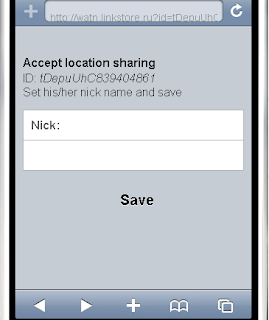
It is obviously, that in this schema each client has got own legends. We can have different names for one ID (each client technically can assign own name).
Implementation. WATN is mobile web application (HTML5). So, we can use localStorage as a persistent store for legends.
Additional options. As soon as you share your location info, you can leave messages attached to your location. WATN users that can read your location data will see your messages too.
And any time you can delete ID (as well as erase all the associated data) from the system.
You can load WATN application right to your mobile browser (iPhone, Android) with the following QR-code:
Direct link is http://watn.linkstore.ru (it is a mobile URL)
P.S. there is another service with the "similar" abbreviation: Where Are You Now.
Actually our Geo Messages project solves problems with privacy. With Geo Messages users can share location info peer to peer as signatures for messages. But it is pure one-to-one relation. What if we need to monitor several people? Here is our new service WATN. It lets you monitor locations for several people, as well as share your own location to some group of people. Obviously, in this case we need some third party server that saves our social graph (who is sharing data to whom). But we can offer the safe solution that does not hurt your privacy.
WATN requires no sign-up. It combines anonymous server-side data with local personalized records.
What if we separate location info and identity data? Just three steps:
a) assign to any participant some unique ID (just an ID, without any links to the personality)
b) save location data on the server with links to the above-mentioned IDs
c) keep the legend (descriptions for IDs, who is behind that ID) locally

In this case any participant may request location data for other participants from third party server (as per sharing rules, of course), get data with IDs and replace IDs (locally) with legend’s data. With such replacement we can show location data in the "natural" form. For example: name (nick) plus location. And in the same time the server (third party server for our users) is not aware about names.
What does it mean technically.
Server keeps location info with IDs:
(a)
ID1 -> (latitude, longitude)
ID2 -> (latitude, longitude)
ID3 -> (latitude, longitude)
Etc.
And social graph – who is sharing location to whom:
(b)
ID1-> (ID2, ID3)
ID3 -> (ID1)
Etc.
Local client keeps legend:
(c)
ID1 -> (name or nick)
ID2 -> (name or nick)
Etc.
The algorithm. Client restores own ID (or obtains a new one). After that client saves location data on the server and obtains shared location data (by the social graph). Client modifies received data and replaces IDs with known names. So, after that our client side application is ready to show location data with names instead of IDs.
Naming. Where are the above-mentioned names (nicks) for IDs come from? WATN uses peer to peer sharing. It means that any user shares own location to another person directly. There are no circles, lists etc. As soon as some user is going to show own location info to another person he simply sends notification about this to another email address (phone number in case of SMS).
Such notification contains some text with explanation "what is it" and, what is obviously should be the main part of this process, a special link to WATN. This link contains an ID for the request originating party.

As soon as this link is fired, WATN application (client) becomes aware about two IDs: own ID1 for this client (see description above) and ID2 from the "shared with you" link (originated request ID). So, if notification is accepted, we can add social graph record (on the server) like
ID2 -> ID1
(client with ID2 shares own location info with the client with ID1. Or client with ID1 identity may read location info for ID2)
But because the notification link comes from email (or SMS) the receiver is aware about the context. He knows simply email headers ('From'), phone number or name in address book SMS comes from. It means the receiver can assign some nick (name) for ID in "shared with you" link. Actually it is a part of confirmation: set some name and confirm. And that name (nick) we can save locally. So, it is like "two phase commit" in databases – save a new social graph record on the server and create a new legend locally.

It is obviously, that in this schema each client has got own legends. We can have different names for one ID (each client technically can assign own name).
Implementation. WATN is mobile web application (HTML5). So, we can use localStorage as a persistent store for legends.
Additional options. As soon as you share your location info, you can leave messages attached to your location. WATN users that can read your location data will see your messages too.
And any time you can delete ID (as well as erase all the associated data) from the system.
You can load WATN application right to your mobile browser (iPhone, Android) with the following QR-code:
Direct link is http://watn.linkstore.ru (it is a mobile URL)
P.S. there is another service with the "similar" abbreviation: Where Are You Now.

Wednesday, October 05, 2011
Geo Messages for Chrome
Geo Messages describes peer to peer approach for sharing location information, where geo data could be transferred as a signature for messages (email, SMS).
There are several implementations for this schema (Java Cards, Android application, mobile HTML5 web applications). And now you can use Geo Messages as Chrome extension too.
There are several implementations for this schema (Java Cards, Android application, mobile HTML5 web applications). And now you can use Geo Messages as Chrome extension too.
Tuesday, October 04, 2011
Visual Geo Search for Layar Vision
This concept of Layar Vision layer associates some geo-data (POIs) with logos of companies. It answers the following questions: how to get nearby devices (places) with the same logo. E.g. each ATM has got bank’s logo. So, it is just a practical case - for any ATM that does not work for example we can find the nearby places with ATMs from the same bank.
Layar Vision layer here is just a wrapper for collection of geo-layer. Each geo-layer describes ATMs for the selected bank. And “bank selection” process coded as a vision enabled layer. User can see bank’s logo on the ATM, recognize it via vision enabled layer and call (switch to) geo-layer (“see more ATMs for the same bank”). We can switch to geo-layer manually (as an action in Layar Vision response) or via auto-trigger.
Search by logo
View more presentations from Coldbeans Software.
Layar Vision layer here is just a wrapper for collection of geo-layer. Each geo-layer describes ATMs for the selected bank. And “bank selection” process coded as a vision enabled layer. User can see bank’s logo on the ATM, recognize it via vision enabled layer and call (switch to) geo-layer (“see more ATMs for the same bank”). We can switch to geo-layer manually (as an action in Layar Vision response) or via auto-trigger.
5 Ways Facebook’s New Features Will Fuel Social Shopping
Interesting. Actually, our QRpon could be also presented as social shopping stuff.
Monday, October 03, 2011
Geo messages for SIM cards
Our presentation for Simagine 2011:
We are among Shortlisted Companies and Products there.
Geo messages for SIM cards
View more presentations from Coldbeans Software
We are among Shortlisted Companies and Products there.
Saturday, October 01, 2011
Chrome installer error
Two laptops - the same deal. Could not install Chrome for Windows XP due to error 0x80040890. Google search shows two things:
a) we are not alone
b) there is no reaction from Google
Bad use case, Google. Will stay with Firefox
a) we are not alone
b) there is no reaction from Google
Bad use case, Google. Will stay with Firefox
SSL for free
I have come across a site http://www.social-server.com. It allows you to convert your existing URL into a secure one (https) for free.
It is for the Facebook developers: all apps, including page tab apps, must migrate to OAuth 2.0 for authentication. The old SDKs, including the old JavaScript SDK (FeatureLoader.js) and old iOS SDK (facebook-iphone-sdk) will no longer work. In addition, iframe Canvas and Page Tab apps must support HTTPS and provide a secure canvas or secure page tab URL.
It is for the Facebook developers: all apps, including page tab apps, must migrate to OAuth 2.0 for authentication. The old SDKs, including the old JavaScript SDK (FeatureLoader.js) and old iOS SDK (facebook-iphone-sdk) will no longer work. In addition, iframe Canvas and Page Tab apps must support HTTPS and provide a secure canvas or secure page tab URL.
Subscribe to:
Comments (Atom)