Monday, October 06, 2014

INJOIT - Call for Papers

The International Journal of Open Information Technologies (INJOIT) is an all-electronic journal with the aim to bring the most recent and unpublished research and development results in the area of information technologies to the scientific and technical societies. Free, peer reviewed papers. English or Russian languages.

The journal is published by the OIT Lab (Open Information Technologies Lab, Faculty of Computational Mathematics and Cybernetics, Lomonosov Moscow State University).

Indexing: Google Scholar, DOAJ, Ulrich's Periodicals Directory, ResearchBib, Elibrary.ru (RINC)

Saturday, October 04, 2014

NFV & SDN

A good reading: "NFV and SDN: Has the Hype Curve Peaked?". Game over?

Sunday, September 28, 2014

Procedia Computer Science

Procedia Computer Science journal - is an electronic product focusing entirely on publishing high quality conference proceedings. Open Access articles.

Tuesday, September 23, 2014

Friday, September 19, 2014

Tweet-a-Program

Wolfram Cloud introduces tweet-a-program. You can send code (Wolfram Language) in a tweet and get back results of its execution. In this connection check out our old 411 for Twitter. It lets you execute your own code behind tweets. See here for t411 examples.

Monday, September 01, 2014

INJOIT - call for papers

The International Journal of Open Information Technologies (INJOIT) is an all-electronic journal with the aim to bring the most recent and unpublished research and development results in the area of information technologies to the scientific and technical societies. Free, peer reviewed papers. English or Russian languages.

The journal is published by the OIT Lab (Open Information Technologies Lab, Faculty of Computational Mathematics and Cybernetics, Lomonosov Moscow State University).

Indexing: Google Scholar, DOAJ, Ulrich's Periodicals Directory, ResearchBib, Elibrary.ru (RINC)

Saturday, August 30, 2014

A real machine learning

Understand the business problem - a good article about the solving real problems with machine learning.

Sunday, August 24, 2014

Network proximity on web

This paper is devoted to context-aware computing. As the basic information about the context, we use information about surrounding wireless networks (Wi-Fi access points, Bluetooth nodes). The aim is to consider the use of this kind of information about network proximity directly in the mobile web applications.

Please, support our presentation

Friday, August 22, 2014

IoT standards

6 emerging standards for IoT. No chances to win with so many "standards" ;-)

Thursday, August 14, 2014

INJOIT - call for papers

The International Journal of Open Information Technologies (INJOIT) is an all-electronic journal with the aim to bring the most recent and unpublished research and development results in the area of information technologies to the scientific and technical societies. Free, peer reviewed papers. English or Russian languages.

It is published by the OIT Lab (Open Information Technologies Lab, Faculty of Computational Mathematics and Cybernetics, Lomonosov Moscow State University).

Indexing: Google Scholar, DOAJ, Ulrich's Periodicals Directory, ResearchBib, Elibrary.ru (RINC)

Thursday, August 07, 2014

M2M Software Platforms

Our new paper: Namiot, D., & Sneps-Sneppe, M. (2014). On M2M Software Platforms. International Journal of Open Information Technologies, 2(8), 29-33.

This paper provides an overview for existing and upcoming system software platforms for M2M applications. In this article we discuss system software models from the developer’s point of view, rather than network related aspects. The primary goal is to find the common and reusable aspects across existing models as well as discuss their possible coexistence. Can we extract the common elements for the different M2M software models? Are there some reusable patterns? What should developers and system architects pay attention to? These are the main issues addressed in this article.

P.S. See also the previous paper: Namiot, Dmitry, and Manfred Sneps-Sneppe. "On M2M Software." International Journal of Open Information Technologies 2.6 (2014): 29-36

Tuesday, August 05, 2014

Open Source Mobile Sensing

Our new paper: Namiot, Dmitry, and Manfred Sneps-Sneppe. "On Open Source Mobile Sensing." Internet of Things, Smart Spaces, and Next Generation Networks and Systems. Springer International Publishing, 2014. 82-94.

The paper discusses phone as a sensor model. For many applied tasks smart phones are an ideal platform for collecting and processing context-related data. The most popular example is, probably, computational social science. Phones can collect data for conducting various social researches about people’s social behavior. This paper presents an attempt to describe and categorize existing open source libraries for mobile sensing, describe architecture and design patterns as well as discover directions for the future development.

Saturday, August 02, 2014

Geo Messages in iOS

Our idea about Geo Messages (geo-signatures for messages) is getting alive with iOS8:

/via GPS Business News

Friday, August 01, 2014

BDP landing page

An interesting idea - Appsites service creates landing pages for mobile applications based on the data in Google Play (App Store).

For example, we can take our BDP application, points service to its page in Google Play and automatically get this landing page for our application: Bluetooth Data Points

Thursday, July 31, 2014

Self-destruct sharing

How to share self-destructing data:

Digify - mobile application
Secure notes - web service and REST API

Monday, July 28, 2014

Directory of mashups

Our mashups directory has been updated. A huge collection of applications: Facebook, Twitter, Google Maps, LBS, QR-codes, mobile HTML5 etc.

The latest release includes for example our new mobile tool: Bluetooth Data Points.

Tuesday, July 22, 2014

Place 2014


We continue to share links for monitoring the interesting events in Twitter. Now it is Place 2014, NY 2014

Place 2014

/via Bluetooth Data Points

API or DPI?

Our new paper: D. Namiot and M. Sneps-Sneppe "On software standards for smart cities: API or DPI"

This paper discusses the global unified standards for software products and existing approaches (de-facto standards). Using specific examples of interaction with Bluetooth Low Energy tags we compared existing approaches to the development and the proposed global standards (FI-WARE). Can a unified approach to the creation of services to cover all the possible use cases and scenarios for new services? The paper emphasizes the need to address the prevailing trends in the design to create a standard. Also, we highlight the critical importance of such a thing as the time to market for new applications and services developed according to the proposed standards.

DOI: 10.1109/Kaleidoscope.2014.6858494

Thursday, July 10, 2014

Check-in advertising

Check-in based advertising is growing dramatically as the popularity of social media increases. This study explores which social cues are appropriate for check-in based advertising in social media based on media richness theory and how content effectiveness affects content generation intention based on achievement motivation theory. - from this paper.

There are several our papers, devoted to check-in advertising:

Namiot, D., & Sneps-Sneppe, M. (2011). Customized check-in procedures. In Smart Spaces and Next Generation Wired/Wireless Networking (pp. 160-164). Springer Berlin Heidelberg.

Namiot, D., & Sneps-Sneppe, M. (2011, October). A new approach to advertising in social networks-business-centric check-ins. In Intelligence in Next Generation Networks (ICIN), 2011 15th International Conference on (pp. 92-96). IEEE.

Wednesday, July 09, 2014

City Chat

QR code
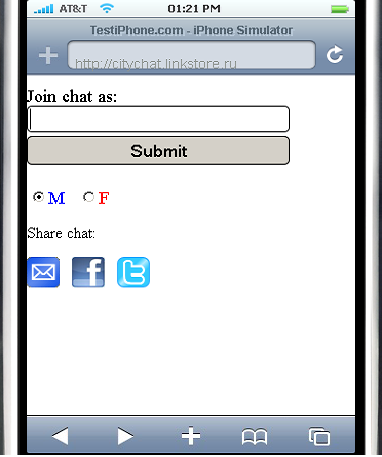
Our mobile mashup City chat has been updated. HTML5 mobile web application lets you talk with other visitors for the same place (café, office etc.). Lets you add on-demand chat service for any particular place. No registration required. Check it out from your iPhone, Android, etc.

http://citychat.linkstore.ru

(it is a mobile site).

You can copy link right to your mobile browser with the QR-code above. Or use the following short URL: http://bit.ly/a7aOKv

You can include chat into your own mobile site. The basic URL accepts the following optional parameters:

lat - a latitude of place
lng - a longitude of place

For example: City chat, Palo Alto.

Techically, it is a mobile web mashup which uses Foursquare and chat engine from Coldbeans.


As a similar "city-related" application see also City forums, geo-chat and Never eat alone application.

Tuesday, July 08, 2014

MobileBeat 2014


We continue to share links for monitoring the interesting events in Twitter. Now it is MobileBeat 2014, San-Francisco 2014

MobileBeat 2014

/via Geo Messages

Local mobile chat

QR code
Our mobile mashup Geo chat has been updated. HTML5 mobile web application lets you chat with other people in the proximity. It is anonymous chat, you do not need a special account. It is just a text chat with people nearby (e.g., in the same café, in traffic jam, etc.) Check out it from the iPhone, Android, or any HTML5 browser.

http://geochat.linkstore.ru

(it is a mobile site).

You can copy link right to your phone with QR-code above. Or use the following short URL http://bit.ly/gCbzm3.

You can use this chat in your own mobile web applications. The basic URL accepts the following optional parameters:

lat - latitude of the place
lng - longitude of the place

for example: Palo Alto, University Avenue, Starbucks

There is the similar mobile mashup City chat - the dialogues there are connected to some place from Foursquare. Geo chat is almost the same, but implemented for any geo place without the connection to some predefined place

Technically, it is a web mashup that uses chat engine from Coldbeans.

As per similar "city-level" applications check out also City forums or City Guide

P.S. as per hyper-local chat see also WiFi chat application

Thursday, July 03, 2014

In-proximity chat & forum

Our mobile web application WiFi chat has been updated again. What kind of object (real or virtual) can we use to unite mobile users? We are not talking here about members of social networks. We are looking a way for creating group chat. Here, for example, is a short list of several our applications:

City forum - discussions (forums) linked to places (POI - point of interest)
Geo forum - the similar to above (also mobile forums) but linked to location
Mobile forum - lets you add discussions to any physical object.
City chat - web chat linked to any POI (point of interest)
Geo chat - web chat linked to some location

And here is our new idea - Wi-Fi Chat. Forum and chat linked to some Wi-Fi network. Communication tools based on ideas of network proximity. It is a mobile application that lets you see available (visible) Wi-Fi networks and link (attach) discussions and chats with them. We are not talking about connecting to Wi-Fi networks. We are using any Wi-Fi network just as a sensor. If you can see it from your mobile, you are somewhere near. We can call it Wi-Fi proximity. That is an idea. All people seeing the same network are in the proximity. So, they could have some common points for the discussions.

Just one interesting remark – Wi-Fi access point could be opened right on the mobile phone. And with WiFi chat application this phone will play a role of presence sensor uniting (combining together) local people for the communications.

Technically this application uses cloud forums from Disqus and web chat from Coldbeans.

You can load .apk right from Android Market:

com.wifichat

Also you can download .apk file right from our server: http://servletsuite.com/WiFiChat.apk. Here is an appropriate QR-code:

QR code for WiFiChat

WiFi chat, actually, is a side project for our new development - SpotEx. This application uses ideas of proximity as a service and lets you attach (link) your own data to Wi-Fi access points. We will describe it separately.

Monday, June 30, 2014

City Forum

City forums.
This mashup combines places from Foursquare and cloud forums from Disqus. Just a place to discuss your city places. It is HTML5, so the whole application works on the mobile phone too (iPhone, Android)

QR code

http://cforum.linkstore.ru

(it is a mobile site).

You can copy this link right to your mobile browser with QR-code above. Alternatively you can use the following short URL: http://bit.ly/aFCbjF


Sunday, June 29, 2014

Directory of mashups

Our mashups directory has been updated. A huge collection of applications: Facebook, Twitter, Google Maps, LBS, QR-codes, mobile HTML5 etc.

The latest release includes for example our new mobile tool: Bluetooth Data Points.

Friday, June 27, 2014

Cisco IoT Challenge

Bluetooth Data Points (BDP) let share and discover data in a local proximity. The main idea behind this approach is doing that without the preliminary scene preparation. BDP model does not require wireless tags, fingerprints (radio maps), etc. An ordinary smart phone is enough for creating own data channel and start sharing (distribute) own data.

BDP approach lets mobile users (enterprises) associate own data snippets with Bluetooth nodes. So, other mobile users in proximity (Bluetooth radio distance) will be able to discover and read them. You can think about the web browsing, where web pages provide some hyper-local data. Read more.

/via Cisco IoT Innovation Grand Challenge

Wednesday, June 25, 2014

Google I/O 2014


We continue to share links for monitoring the interesting events in Twitter. Now it is Google I/O 2014, San-Francisco 2014

Google I/O 2014

/via Geo Messages

Sunday, June 22, 2014

Saturday, June 21, 2014

Tuesday, June 17, 2014

Monday, June 02, 2014

BDP - Bluetooth Data Points

More information about Bluetooth Data Points

Bluetooth Data Points (BDP) is a new approach for creating mobile services with wireless tags. It is a yet another use case for the network proximity. Mobile application (Android) lets any user post some announce (advertising, classified, etc.) and associate it with Bluetooth node on the phone. The same application on another phone can scan nearby Bluetooth nodes and collect local announces. Dislike iBeacon and similar applications:

a) this approach is based on the Core Bluetooth rather than on Bluetooth Low Energy. So it will work with any phone;

b) this application works like a browser. So, mobile user decides when to run and what to read rather than constantly get unwanted notifications.

The following picture illustrates BDP (Bluetooth Data Points) approach:

BDP uses Core Bluetooth. So, it could be used with almost any smartphone. Let us see how it works:

1. Mobile user can browse local announces:

2. Another user publish own announce:

It is simply a text. User can publish links (URLs), email, phone or links to Twitter: @t411

3. Application switch on Bluetooth for published announces:

Of course, the publisher can switch Bluetooth off and make own announces unavailable. And later, switch it on again, etc. So, publisher's announces will follow his phone. When published materials are on, other mobile users nearby will the them:

Mobile application for Android, which implements this approach could be downloaded right from Google Play: BDP on Google Play. Here is an appropriate QR-code:

QR code for BDP

You can download it right from our site too: BDP on servlewtsuite. And here is an appropriate QR-code:

QR code for BDP

As the possible use cases for this approach we can mention applications for retail, indoor navigation, as well as context-dependent services for Smart Cities.

P.S. We've used the similar approach for Wi-Fi: SpotEx

Wednesday, May 28, 2014

Distributed computing

A great article about paradigm shift in programming: all computing has become distributed computing. The age of standalone applications has disappeared, and applications that run on a single computer are almost inconceivable.

Sunday, May 25, 2014

More about Bluetooth Data Points

More information about Bluetooth Data Points

Bluetooth Data Points (BDP) is a new approach for creating mobile services with wireless tags. It is a yet another use case for the network proximity. Mobile application (Android) lets any user post some announce (advertising, classified, etc.) and associate it with Bluetooth node on the phone. The same application on another phone can scan nearby Bluetooth nodes and collect local announces. Dislike iBeacon and similar applications:

a) this approach is based on the Core Bluetooth rather than on Bluetooth Low Energy. So it will work with any phone;

b) this application works like a browser. So, mobile user decides when to run and what to read rather than constantly get unwanted notifications.

The following picture illustrates BDP (Bluetooth Data Points) approach:

BDP uses Core Bluetooth. So, it could be used with almost any smartphone. Let us see how it works:

1. Mobile user can browse local announces:

2. Another user publish own announce:

It is simply a text. User can publish links (URLs), email, phone or links to Twitter: @t411

3. Application switch on Bluetooth for published announces:

Of course, the publisher can switch Bluetooth off and make own announces unavailable. And later, switch it on again, etc. So, publisher's announces will follow his phone. When published materials are on, other mobile users nearby will the them:

Mobile application for Android, which implements this approach: BDP (Bluetooth Data Point). You can download it right from our site servletsuite.com. And here is an appropriate QR-code:

QR code for BDP

As the possible use cases for this approach we can mention applications for retail, indoor navigation, as well as context-dependent services for Smart Cities.

P.S. We've used the similar approach for Wi-Fi: SpotEx

Saturday, May 24, 2014

Bluetooth Data Points

Here is a yet another use case for the network proximity. Mobile application (Android) lets any user post some announce (advertising, classified, etc.) and starts Bluetooth on the phone. The same application on another phone can scan nearby Bluetooth nodes and collect local announces. Dislike iBeacon and similar applications:

a) this approach is based on the Core Bluetooth rather than on Bluetooth Low Energy. So it will work with any phone;

b) this application works like a browser. So, mobile user decides when to run and what to read rather than constantly getting unwanted notifications

The following picture illustrates BDP (Bluetooth Data Points) approach:

You can download this application right from our server: BDP.apk

QR code for BDP


Sunday, May 18, 2014

Data Mining

A good collection: free books on Data Mining

Thursday, May 08, 2014

Thursday, April 24, 2014

Tuesday, April 15, 2014

ECIR 2014


We continue to share links for monitoring the interesting events in Twitter. Now it is ECIR Conference 2014, Amsterdam 2014

ECIR 2014

/via Geo Messages

Wednesday, April 09, 2014

WWW 2014


We continue to share links for monitoring the interesting events in Twitter. Now it is World Wide Web Conference 2014, Seoul 2014

WWW 2014

/via Geo Messages

Wednesday, April 02, 2014

EU Future Internet


We continue to share links for monitoring the interesting events in Twitter. Now it is 1st European Conference on the Future Internet, Brussels 2014

ECFI tweets

/via Geo Messages

Online Courses

Search for online courses: http://courses.linkstore.ru

Monday, March 31, 2014

Wednesday, March 26, 2014

INJOIT - call for papers

The International Journal of Open Information Technologies (INJOIT) is an all-electronic journal with the aim to bring the most recent and unpublished research and development results in the area of information technologies to the scientific and technical societies. Free, peer reviewed papers. English or Russian languages.

It is published by the OIT Lab (Open Information Technologies Lab, Faculty of Computational Mathematics and Cybernetics, Lomonosov Moscow State University).

Indexing: Google Scholar, DOAJ, Ulrich's Periodicals Directory, ResearchBib, Elibrary.ru (RINC)

Wednesday, March 12, 2014

Semantic Web and IoT

"The Internet of Things is coming, but it needs a semantic backbone to flourish" - from here.

Monday, March 10, 2014

LWM2M protocol

Lightweight M2M: Enabling Device Management and Applications for the Internet of Things - a new OMA standard.

Tuesday, March 04, 2014

IoT EU Summit


We continue to share links for monitoring the interesting events in Twitter. Now it is IoT EU Summit 2014, Brussels 2014

IoT EU Summit tweets

/via Geo Messages

Monday, March 03, 2014

SXSW 2014


We continue to share links for monitoring the interesting events in Twitter. Now it is SXSW 2014, Austin 2014

SXSW tweets

/via Geo Messages

Thursday, February 27, 2014

Search for online courses

Our mashup based on Google Custom Search Engine - Search for Online Courses. 110 sites. And you can discuss search results right on the page via TogetherJS from Mozilla.

Tuesday, February 25, 2014

MWC 2014


We continue to share links for monitoring the interesting events in Twitter. Now it is MWC 2014, Barselona 2014

MWC tweets

/via Geo Messages

Monday, February 24, 2014

IoT framework

Yet another IoT framework. Now the whole picture looks similar to Java web frameworks - there are more IoT frameworks than developers for them.

Friday, February 14, 2014

Mobile Services on Wi-Fi Proximity Base

Our paper in IJESIT: Yousef Daradkeh, Tariq (Moh’d Taisir) Al Omari, and Dmitry Namiot "Mobile Services on Wi-Fi Proximity Base". International Journal of Engineering Science and Innovative Technology (IJESIT), Vol. 3, Issue 1, 2014. pp.24-35

This paper describes a new model for delivering hyper-local data for mobile subscribers. Our model uses Wi-Fi proximity as a service. According to this concept, any existing or even a specially created Wi-Fi hot spot could be used as presence sensor that can trigger access for some user-generated information snippets. In this article we present several examples for deployment: context-aware browser, integration for proximity and social streams and human dynamics models based on proximity data. As the possible use-cases, we can mention, for example, news and deals delivery in malls, news feeds for office centers and campuses, social curation, Smart City projects, personal classifieds, etc.

Thursday, February 13, 2014

Friday, February 07, 2014

Postdoc positions

4 postdoc positions are available in top Russian university: robots, AI, big data. Working language is English, a good package.

Send CV to info@servletsuite.com

Thursday, February 06, 2014

Twitter Data Grants

"With more than 500 million Tweets a day, Twitter has an expansive set of data from which we can glean insights and learn about a variety of topics, from health-related information such as when and where the flu may hit to global events like ringing in the new year. To date, it has been challenging for researchers outside the company who are tackling big questions to collaborate with us to access our public, historical data. Our Data Grants program aims to change that by connecting research institutions and academics with the data they need." - from Twitter

Wednesday, February 05, 2014

INJOIT - call for papers

The International Journal of Open Information Technologies (INJOIT) is an all-electronic journal with the aim to bring the most recent and unpublished research and development results in the area of information technologies to the scientific and technical societies. Free, peer reviewed papers. English or Russian languages. Here you can see the archive.

It is published by the OIT Lab (Open Information Technologies Lab, Faculty of Computational Mathematics and Cybernetics, Lomonosov Moscow State University).

Thursday, January 30, 2014

Sunday, January 26, 2014

Sunday, January 19, 2014

DLD 2014


We continue to share links for monitoring the interesting events in Twitter. Now it is DLD 2014, Munich 2014

DLD tweets

/via Geo Messages

Tuesday, January 14, 2014

Saturday, January 11, 2014

Data-Driven Discovery Initiative

Data-Driven Discovery Initiative seeks to advance the people and practices of data-intensive science, to take advantage of the increasing volume, velocity, and variety of scientific data to make new discoveries. Within this initiative, we’re supporting data-driven discovery investigators – individuals who exemplify multidisciplinary, data-driven science, coalescing natural sciences with methods from statistics and computer science.

It is anticipated that the DDD initiative will make about 15 awards at ~$1,500,000 each, at $200K-$300K/year for five years.

read more here.

Friday, January 10, 2014

Thursday, January 09, 2014

INJOIT: call for papers

The International Journal of Open Information Technologies (INJOIT) is an all-electronic journal with the aim to bring the most recent and unpublished research and development results in the area of information technologies to the scientific and technical societies. Free, peer reviewed papers. English or Russian languages.

It is published by the OIT Lab (Open Information Technologies Lab, Faculty of Computational Mathematics and Cybernetics, Lomonosov Moscow State University).

Monday, January 06, 2014

CES 2014


We continue to share links for monitoring the interesting events in Twitter. Now it is CES 2014, Las Vegas 2014

CES tweets

/via Geo Messages

P2P framework

From the recent read: "ConnectEnc: Encounter-based Connections & Opportunistic Trust in Mobile Networks". But it looks like the core P2P functionality is missed. At least, in the paper.

Thursday, January 02, 2014

Mining relationships in proximity movements

A new paper about mining relationships in proximity movements has been published in APPLIED MATHEMATICAL SCIENCES Journal.

Saturday, December 28, 2013

Search for online courses

Our mashup based on Google Custom Search Engine - Search for Online Courses. 105+ sites. And discuss your result right on the page via TogetherJS from Mozilla.

Sunday, December 22, 2013

M2M & Smart Cities

Machine-to-Machine in Smart Grids & Smart Cities: Technologies, Standards & Applications.


Friday, December 20, 2013

Social Streams

A new paper has been published in International Journal of Space-Based and Situated Computing. This paper describes a new approach for using wireless sensors on mobile phones for integrating data from social networks. See Social streams based on network proximity.

Saturday, December 14, 2013

About mobile sensing

Here is the list of open source mobile libraries for collecting data from sensors (in no particular order):

What is missed? New suggestions are more than welcome.

Tuesday, December 10, 2013

LeWeb 2013


We continue to share links for monitoring the interesting events in Twitter. Now it is LeWeb 2013, Paris 2013

LeWeb tweets

/via Geo Messages

Saturday, December 07, 2013

Time-series databases

An actual question in connection with M2M and Smart Cities tasks - Open source databases for time-series, events and metrics. E.g.:

What is else?

Thursday, December 05, 2013

Blacklisted journals

There are 4 publishers not recognized by Malaysia Ministry of Higher Education (MOHE):

  • EuroJournals Inc.
  • Common Ground Publishing
  • Academic Journals
  • African World Press

See list of journals here.

Tuesday, December 03, 2013

AppNation 2013


We continue to share links for monitoring the interesting events in Twitter. Now it is AppNation 2013, SF 2013

AppNation tweets

/via Geo Messages

i-ASC 2014

Monday, December 02, 2013